
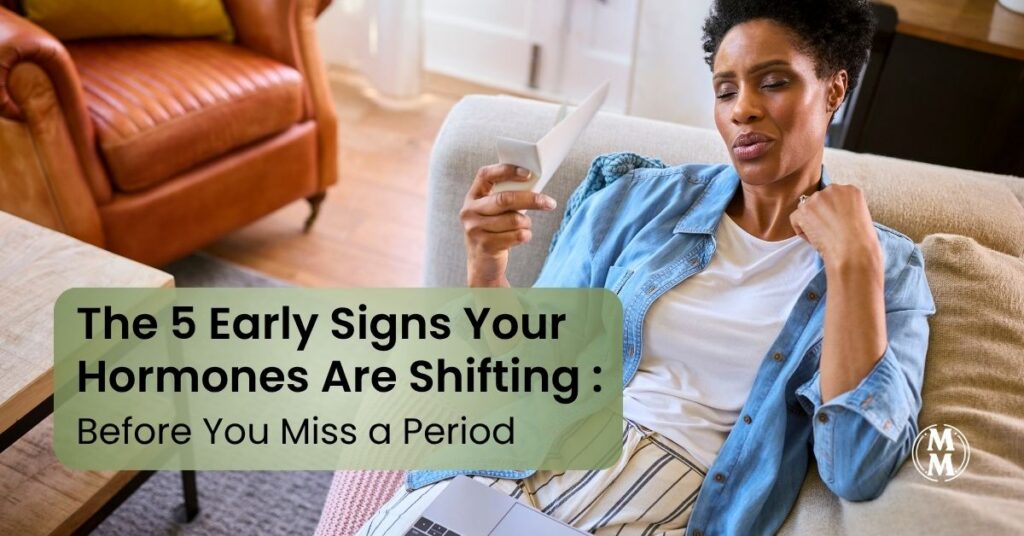
The 5 Early Signs Your Hormones Are Shifting (Before You Miss a Period)
Sub-Heading: Use as short quote or teaser.
🗂️ Hormone Health | Gut Health
📅 May 24, 2026
🏷️ Hormones | Perimenopause
Quick Hormone Health Takeaways
You Don’t Just Wake Up One Day With Hormone Problems
Most women expect hormone changes to announce themselves clearly.
A missed period.
Hot flashes.
Something obvious enough that you can point to and say, there it is.
But that is not how this usually begins.
What actually happens is quieter, and because of that, much easier to dismiss. It often starts with sleep. You wake up in the middle of the night and cannot quite settle back in. Not fully awake, not fully asleep—just aware enough that rest slips through your fingers. The next day, you feel it, but not in a way that feels dramatic. You are simply a little less steady than usual. A little less patient. A little more reactive than you would expect.
Around the same time, your body begins responding differently. The habits that used to feel reliable no longer produce the same result. You are not doing anything wildly different, and yet something feels off. It is subtle enough that you question it, but persistent enough that you cannot ignore it completely.
So you keep going. You assume it is stress, or lack of sleep, or just a busy season. And if you happen to run labs during this time and they come back normal, that reinforces the idea that nothing meaningful is happening.
Except something is.
The problem is not that your body is failing. The problem is that you have not been taught how to read what it is telling you. Hormone shifts rarely begin with disruption. They begin with changes in rhythm, and those changes show up as signals long before they show up as diagnoses.
This is the part most women miss. These early shifts are signals, not problems—and once you learn how to read them, everything starts to make more sense.
Why Hormone Changes Start Before You Notice
Hormones operate as part of a larger system, not as isolated switches. They respond continuously to sleep, stress, food, inflammation, and overall demand on the body. When that system begins to shift, it does not move in one clean step. It adjusts gradually, often through compensation.
That compensation phase is where most women get confused.
Progesterone typically begins to decline first, which can affect sleep quality and the ability to feel calm and settled. Estrogen does not simply decrease; it fluctuates, sometimes significantly, creating instability before any clear pattern emerges. Cortisol often steps in to help maintain balance, especially in bodies that have been under consistent stress.
From a lab perspective, this can still look normal. From a lived perspective, it feels different.
That difference matters. It reflects the body working harder to maintain equilibrium, and that extra effort is often what you experience as subtle symptoms. Early hormone change is not about collapse—it is about a system adapting under shifting conditions.
What you’re about to see isn’t a random list of symptoms. It’s a pattern. And the goal isn’t to fix each one individually—it’s to understand what your body is trying to tell you through them.
If you want a deeper breakdown of what’s actually
happening hormonally during this phase, start with
Hormones in Midlife: What’s Happening to Me?
The First Signs Most Women Ignore
These early signals are easy to overlook because they do not feel extreme. They show up as patterns, not emergencies, which makes them easy to rationalize away. If several of these feel familiar, you’re not imagining it—this is often how midlife symptoms begin to show up before anything looks obvious on paper.
1. Sleep Starts Breaking First
Sleep disruption is often the earliest and most consistent sign.
You may fall asleep without issue, but wake in the middle of the night and struggle to return to deep rest. Or you sleep through the night but wake feeling as though you never fully recovered. This is often tied to changes in progesterone and the timing of cortisol, both of which influence how deeply and consistently you sleep.
When sleep begins to shift, it affects everything that follows. Energy, mood, cravings, and stress tolerance all become harder to interpret when rest is no longer reliable.
2. Mood Feels Less Stable
Mood changes in this phase are often misinterpreted as emotional or situational when they are actually physiological.

You may find yourself reacting more quickly, feeling more sensitive, or taking longer to recover from stress. The circumstances around you may not have changed, but your response to them has. This is often linked to fluctuations in estrogen, which influences neurotransmitters involved in mood and emotional regulation.
For some women, this also shows up as increased sensitivity to things they never reacted to before, which can be connected to how histamine and hormones interact.
The key here is not to dismiss these changes as personality flaws. They are often early indicators of shifting chemistry.
3. Your Body Composition Starts Changing
This is where many women begin to question themselves.
You are eating in a way that used to work. You are moving in ways that used to feel effective. Yet your body begins to respond differently. Weight may distribute differently, particularly around the midsection, and maintaining muscle can feel more difficult.
These changes are tied to shifts in insulin sensitivity, estrogen, and cortisol. The body is reallocating resources based on internal signals, not ignoring your effort.
This is not a discipline issue. It is a change in how your body is processing what you give it.
4. Energy Becomes Less Predictable
Energy may start to feel inconsistent rather than steadily low or high.
You can have a day where everything feels normal, followed by a day where you feel depleted without a clear reason. This often reflects changes in how your body is managing blood sugar and stress hormones throughout the day.
The inconsistency itself is the signal.
5. You Feel “Off” Without a Clear Explanation
This is the most dismissed and often the most important signal.
There is a general sense that your baseline has shifted. You may feel less resilient, less stable, or simply not quite like yourself. There is no single symptom you can point to, which makes it easy to ignore, but the overall pattern is meaningful.
This is where awareness becomes critical. Noticing this shift early allows you to respond before it compounds into something more difficult to manage.
You’re Not Broken.
You’re Just Overloaded.
If you’re ready to go deeper and actually support what your body is signaling, Reset Mode walks you through it step-by-step.
Why This Matters
These early changes do not stay isolated.
When they are ignored, they tend to compound across systems. Sleep disruption affects energy and mood. Blood sugar instability affects cravings and weight. Chronic stress affects hormone balance and recovery.
Over time, what begins as subtle inconsistency can become persistent fatigue, increased inflammation, metabolic resistance, and more pronounced hormonal symptoms.
This is also the point where many women begin to internalize the problem. They assume they are doing something wrong or that they need to push harder to get back to where they were.
That approach usually makes things worse.
Understanding what is happening early changes how you respond, and that response determines how these patterns develop.
What’s Driving These Early Changes
These shifts are rarely caused by a single factor. They are the result of multiple systems interacting over time.
The most common drivers include:
- Declining progesterone, affecting sleep and nervous system regulation
- Fluctuating estrogen, creating instability before decline
- Chronic stress load, increasing reliance on cortisol
- Blood sugar dysregulation, influencing energy and fat storage
- Gut health changes, affecting how hormones are processed
Hormones are not operating independently. They reflect the combined state of these systems.
How Hormones Connect to Everything Else
Hormones respond to the conditions they are given.
Gut health influences how estrogen is metabolized and cleared. Stress affects the balance between cortisol and progesterone. Blood sugar stability impacts energy, mood, and fat storage. Inflammation interferes with signaling across multiple systems.
This is why focusing only on hormones often feels ineffective. The underlying drivers remain unchanged. For example, the way you eat directly influences how your body processes hormones, which is why even things like skin changes can reflect deeper internal shifts.
Bottom line? Supporting hormones requires supporting the systems they depend on.
If You’re Starting to Connect the Dots
If this feels familiar, the goal is not to fix everything at once.
It is to recognize that these patterns are connected and to begin responding to them with that understanding.
Supporting inflammation and cell health becomes increasingly important here, especially as your body becomes more sensitive to stress and recovery patterns.
How to Respond: Signal → Seek → Shift → Support
Signal (What to Notice)
Start by paying attention to patterns—sleep, mood, energy, and how your body responds day to day. You’re not looking for perfection. You’re learning what’s changing.
Seek (What It Means)
Next, begin connecting the dots. Look for relationships between stress, food, sleep, and how you feel. This is where symptoms stop feeling random and start making sense.
Shift (What to Adjust)
From there, make small, strategic changes. Support blood sugar, improve sleep rhythm, and reduce unnecessary stress where possible. The goal is not to overhaul everything—it’s to respond intelligently.
Support (What to Sustain)
This is where most people fall off. Your body doesn’t need a short-term fix—it needs consistent support. The patterns you’re seeing didn’t develop overnight, and they won’t resolve that way either.
Coach’s Insight
Most women are taught to wait until something is clearly wrong before they respond. But the body doesn’t work that way. It signals early, long before anything shows up on paper. If you learn to recognize those signals and respond to them, you don’t end up chasing symptoms later—you change the direction early.
“Your hormones don’t crash overnight — they whisper first.”
~ Coach Joni
Wrapping It Up
Nothing here is random.
These changes reflect a system that is adjusting, not failing. The earlier you recognize that, the more effectively you can respond.
You are not behind. You are not broken.
You are seeing the shift earlier than most.
This is what it looks like to work with your body instead of against it—learning to notice, understand, respond, and support before things spiral.
Start here → Reset Mode: Gut Edition
Perimenopuase FAQ: What You Need to Know
1. Are these signs always perimenopause?
Not always—but they are very often early indicators that your hormonal rhythm is shifting.
The mistake most women make is waiting for a label before they take these changes seriously. Your body doesn’t wait for a diagnosis to start adapting, and it doesn’t need one for you to begin paying attention. Whether this is early perimenopause or a stress-driven shift in your system, the pattern still matters—and how you respond to it still matters.
2. Why do my labs say everything is normal?
Because early hormone changes are not just about levels—they’re about timing, rhythm, and fluctuation.
Most standard lab tests capture a single moment in time. They don’t show how your hormones are behaving across a full cycle or how they’re interacting with stress, sleep, and metabolism. So it’s entirely possible to feel different while still falling inside a “normal” range on paper.
This is where learning to read your own patterns becomes just as important as any test result.
3. Can I support this naturally?
Yes—but “naturally” doesn’t mean casually.
Supporting your body in this phase usually comes down to the basics done consistently: stabilizing blood sugar, improving sleep quality, managing stress load, and supporting gut health. These are not small things. They are the foundation your hormones are built on.
The key is not doing everything at once. It’s choosing a few areas to support and staying with them long enough for your body to respond.
4. What’s the first step?
Awareness—but not in a vague way.
Start noticing patterns. When you wake up. When your energy dips. What your mood feels like across the day. What tends to throw you off. You’re not trying to control everything—you’re trying to understand what’s changing.
Once you see the pattern, your next steps become much clearer. Without that awareness, you end up guessing and reacting instead of responding.
5. Is this just aging?
No. Aging is the context—but this is a physiological shift.
Your body is recalibrating how it manages energy, stress, and hormones. That process is not random, and it’s not something you’re powerless in. How you respond during this phase plays a significant role in how you experience it.
This isn’t about stopping change. It’s about understanding it early enough to move with it instead of fighting it.
Referenced Studies & Sources
| Title | Link |
|---|---|
| Efficacy of Micronized Progesterone for Sleep: A Systematic Review and Meta-Analysis of Randomized Controlled Trial Data | https://pubmed.ncbi.nlm.nih.gov/33245776/ |
| Insomnia and Menopause: A Narrative Review on Mechanisms and Treatments | https://pubmed.ncbi.nlm.nih.gov/32880197/ |
| The Role of Estradiol Fluctuation in the Pathophysiology of Perimenopausal Depression: A Hypothesis Paper | https://pubmed.ncbi.nlm.nih.gov/34607269/ |
| Symptoms During the Menopausal Transition and Early Postmenopause and Their Relation to Endocrine Levels Over Time: Observations From the Seattle Midlife Women’s Health Study | https://pubmed.ncbi.nlm.nih.gov/17627402/ |
| Acute Consequences of the Menopausal Transition: The Rise of Common Menopausal Symptoms | https://pubmed.ncbi.nlm.nih.gov/15501640/ |
| Understanding Weight Gain at Menopause | https://pubmed.ncbi.nlm.nih.gov/22978257/ |
| Menopause-Related Changes in Body Fat Distribution | https://pubmed.ncbi.nlm.nih.gov/10865795/ |
| Estrogen-Gut Microbiome Axis: Physiological and Clinical Implications | https://pubmed.ncbi.nlm.nih.gov/28778332/ |
Explore by Pillar

Build a clean foundation without the overwhelm.

Banish bloat, balance bugs, & get your rhythm back. Fast!

Decode midlife shifts & feel like yourself again.

From spirals to steady — regulate with grit & grace.

Age-defying habits for women who still want to glow.

You’re not done — you’re just getting started. Buckle Up!