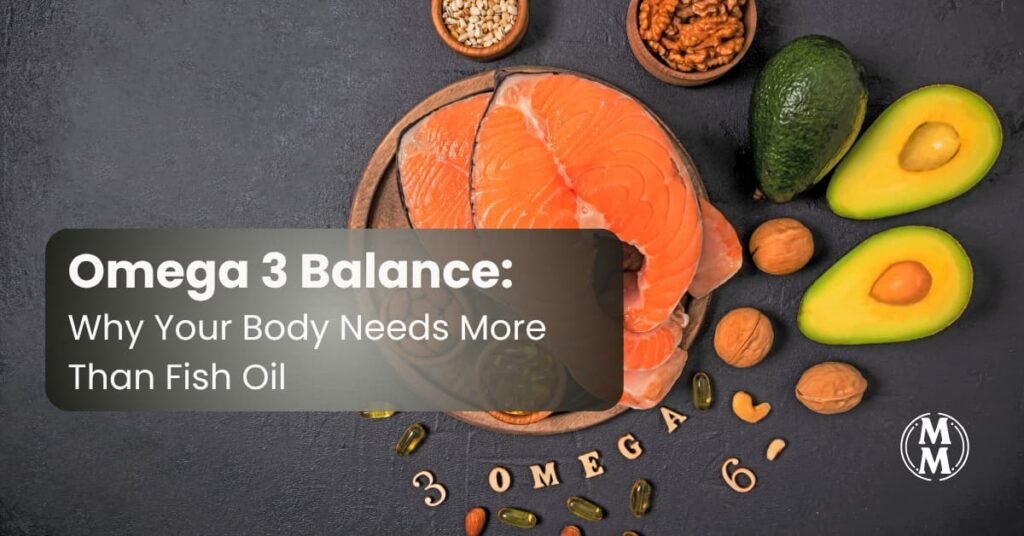
Omega-3 Balance:
Why Your Body Needs More Than Fish Oil
🗂️ Longevity & Aging
📅 April 27, 2026
🏷️ Supplements | Omegas
Quick Longevity Takeaways
- You Can Take Fish Oil Every Day… and Still Be Inflamed
- What Are Omega-3s (And Why Your Body Actually Cares)
- Omega-3 vs Omega-6: The Ratio That Quietly Runs Everything
- Seed Oils: The Hidden Driver of Chronic Inflammation
- Food First: The Smartest Way to Restore Balance
- Do You Actually Need a Supplement? (Let’s Be Honest)
- Why Omega-3 Balance Matters More in Midlife
- Why This Actually Starts Showing Up in Your Life
- How to Actually Improve Your Omega-3 Balance
- Smart Cart. Clean Start.
- Clean Eating
- Gut Health
- Hormone Health
- Mood & Mind
- Longevity
- Reinvention
You Can Take Fish Oil Every Day… and Still Be Inflamed
Let’s just say it out loud:
You can take all the fish oil in the world… and still feel stiff, foggy, and inflamed.
Because this isn’t just about getting more omega-3s. It’s about the imbalance running quietly underneath everything.
Most women in midlife aren’t deficient.
They’re outnumbered.
Outnumbered by omega-6 fats flooding in from processed foods, restaurant oils, and “healthy” snacks that aren’t so healthy after all.
And until that imbalance is addressed?
No supplement is coming in to save the day.
What Are Omega-3s (And Why Your Body Actually Cares)
Omega-3 fatty acids are essential fats — meaning your body can’t make them. You have to bring them in.
The key players:
- ALA (plant-based)
- EPA & DHA (marine-based — the heavy hitters)
These aren’t just “nice to have.”
They’re baked into your biology.
Omega-3s support:
- Cell membrane flexibility
- Brain function and mood
- Anti-inflammatory signaling
- Hormone communication
- Skin integrity and aging
This is where it stops being about ‘healthy fats’ and starts being about how your body actually functions day to day.
Here’s the translation you actually care about:
👉 Clearer thinking
👉 Less joint stiffness
👉 More stable energy
👉 Better recovery
This isn’t about supplements.
It’s about how your cells talk to each other.
Omega-3 vs Omega-6: The Ratio That Quietly Runs Everything
This is where most people get it wrong.
Omega-6 fats are not the enemy.
They’re necessary.
But they were never meant to dominate the conversation.
What the balance should look like:
- Historically: ~1:1 to 1:4
- Today: 15:1 to 25:1 (or worse)
That’s not a small shift.
That’s a biochemical takeover.
When omega-6 fats dominate:
- Inflammatory pathways get turned up
- Recovery slows down
- Hormonal signaling becomes less efficient
- The body stays in a low-grade stress state
Inflammation isn’t random — it’s often a ratio problem.
~ Coach Joni
Your body isn’t broken.
It’s responding — exactly the way it was designed to.
Seed Oils: The Hidden Driver of Chronic Inflammation
If omega-6 overload is the problem…
seed oils are the delivery system.
The biggest offenders:
- Soybean oil
- Corn oil
- Canola oil
- Sunflower & safflower oil
They’re everywhere:
- Salad dressings
- Packaged snacks
- Restaurant food
- “Clean” protein bars
And here’s the kicker:
They’re extremely high in linoleic acid, a type of omega-6 fat that:
- Accumulates in tissues
- Is prone to oxidation
- Drives inflammatory signaling when excessive
This isn’t about fear. It’s about volume and frequency. You cannot out-supplement a daily overload.
Here’s the part most people don’t realize:
Linoleic acid from these oils doesn’t just pass through.
It accumulates in your tissues over time.
And because these oils show up in foods you eat daily — not occasionally —
the load builds quietly in the background.
Not from one meal.
From hundreds of small exposures.
That’s why this isn’t about perfection.
It’s about reducing the daily drip. Make sense?
Food First: The Smartest Way to Restore Balance
Before we even talk supplements…
We fix the foundation.
Best whole food omega-3 sources:
- Wild-caught salmon
- Sardines
- Mackerel
- Anchovies
Also helpful:
- Pastured eggs
- Grass-fed meats (supportive, not primary)
What about flax and chia?
They contain ALA — which is great…
but conversion to EPA/DHA is extremely limited.
So yes, include them.
But don’t rely on them.
This isn’t about eating perfectly.
It’s about shifting what shows up most often.
Food works because it comes with context
~ Coach Joni
— not isolated fragments.
Do You Actually Need a Supplement? (Let’s Be Honest)
Sometimes? Yes.
But not for the reasons most people think.
Supplementation makes sense if:
- You rarely eat fatty fish
- You’re dealing with inflammation
- You’re in midlife hormonal shifts
- You want cognitive or cardiovascular support
It won’t help much if:
- Your diet is still heavy in seed oils
- You expect a capsule to override daily inputs
Reframe: A supplement is support — not a shortcut.
If you want to keep this simple, use this filter:
- If you’re not eating fatty fish regularly → a supplement can help
- If your diet is still heavy in processed or restaurant foods → fix that first
- If you’re already eating well but want added support → supplement strategically
No guessing. No overthinking.
Just context.
Fish Oil vs Krill Oil: What Your Body Can Actually Use
This is where things get interesting.
Fish Oil
- Contains EPA/DHA in triglyceride or ethyl ester form
- Widely available
- Quality varies significantly
Krill Oil
- EPA/DHA bound to phospholipids
- Easier integration into cell membranes
- Contains astaxanthin (a built-in antioxidant)
What this means for you:
Krill oil may offer:
- Better absorption
- Better cellular uptake
- Lower dose effectiveness
But:
- It’s more expensive
- Not always necessary for everyone
It’s not just what you take
~ Coach Joni
— it’s what your body can use.
So what should you actually do?
If you’re just getting started: → A high-quality fish oil is a solid, accessible option
If you want better absorption and are willing to invest: → Krill oil is worth considering
If your foundation isn’t dialed in yet: → Neither one is your first move
Why Omega-3 Balance Matters More in Midlife
Midlife isn’t decline.
It’s increased sensitivity to imbalance.
As hormones shift:
- Inflammation hits harder
- Recovery slows
- Brain fog becomes more noticeable
- Joint stiffness creeps in
Omega-3s help support:
- Brain health
- Hormonal signaling
- Cardiovascular resilience
- Skin aging
This matters because it affects how you feel, think, and move — not just your labs.
Why This Actually Starts Showing Up in Your Life
This isn’t theoretical.
This is the slow creep.
It looks like:
- Waking up stiff when you didn’t used to
- Brain fog that makes you reread the same sentence twice
- Energy dips that hit harder than they should
- Skin that feels thinner, drier, less resilient
- Recovery that takes longer… and longer… and longer
Nothing dramatic.
Nothing diagnosable.
Just enough to make you think:
“Is this just aging?”
But often?
It’s not age.
It’s signaling.
And when inflammation quietly stays elevated — day after day —
your body starts adapting to that state like it’s normal.
How to Actually Improve Your Omega-3 Balance
Keep this simple. This is not a 47-step protocol.
- Reduce seed oils first – That’s the lever.
- Add omega-3-rich foods – 2–3 servings of fatty fish per week
- Supplement if needed – Choose quality over hype
- Stay consistent – This is about direction, not perfection
Coach’s Corner: The Part Nobody Wants to Hear (But Needs To)
You don’t have an omega-3 deficiency problem.
You have a modern food environment problem.
And I say that with love — because I’ve lived it too.
We’ve been handed convenience, shelf life, and marketing…
and told it was health.
But your body knows the difference.
This is why I teach:
Clean eating starts at the cart — not in a capsule.
Because when you change what comes into your home…
everything downstream gets easier.
And that’s where real, sustainable change begins.
You don’t need a better supplement. You need a cleaner signal.
If this clicked for you — start where it matters most:
Because the fastest way to shift inflammation isn’t another supplement…
It’s changing what shows up in your kitchen every week.
Smart Cart. Clean Start.
Download your free guide to shop cleaner, label smarter, & set yourself up for clean eating success — without the overwhelm.
Omega-3 Balance FAQ: What You Need to Know
1. What is the ideal omega-3 to omega-6 ratio?
Ideally between 1:1 and 1:4. Most modern diets are closer to 15:1 or higher, which promotes inflammation.
2. Can I get enough omega-3 from food alone?
Yes — if you consistently eat fatty fish 2–3 times per week. Many people don’t, which is where supplements can help.
3. Is fish oil worth taking daily?
It can be beneficial, especially if your diet lacks omega-3-rich foods. But it won’t override a high omega-6 intake.
4. Is krill oil better than fish oil?
Krill oil may be better absorbed due to its phospholipid structure, but both can be effective depending on quality.
5. Do omega-3s help reduce inflammation?
Yes. Omega-3s help regulate inflammatory pathways, especially when balanced with reduced omega-6 intake.
Referenced Studies & Sources
| Title | Link |
| The Importance Of The Omega-6/Omega-3 Fatty Acid Ratio In Cardiovascular Disease And Other Chronic Diseases | https://pubmed.ncbi.nlm.nih.gov/12442909/ |
| Omega-3 Fatty Acids And Inflammatory Processes: From Molecules To Man | https://www.ncbi.nlm.nih.gov/pmc/articles/PMC3257651/ |
| Dietary Intake Of Linoleic Acid And Risk Of Coronary Heart Disease: A Systematic Review And Meta-Analysis Of Prospective Cohort Studies | https://pubmed.ncbi.nlm.nih.gov/25161045/ |
| Conversion Of Alpha-Linolenic Acid To Eicosapentaenoic, Docosapentaenoic And Docosahexaenoic Acids In Young Women | https://pubmed.ncbi.nlm.nih.gov/9637947/ |
| Incorporation Of EPA And DHA Into Plasma Phospholipids In Response To Different Omega-3 Fatty Acid Formulations—A Comparative Bioavailability Study Of Fish Oil Vs. Krill Oil | https://pubmed.ncbi.nlm.nih.gov/20368399/ |
| Omega-3 Fatty Acids EPA And DHA: Health Benefits Throughout Life | https://pubmed.ncbi.nlm.nih.gov/10479465/ |
| Linoleic Acid: A Narrative Review Of The Effects Of Increased Intake In The Standard American Diet And Associations With Inflammation And Chronic Disease | https://www.ncbi.nlm.nih.gov/pmc/articles/PMC10386285/ |
Explore by Pillar

Clean Eating
Build a clean foundation without the overwhelm.

Gut Health
Banish bloat, balance bugs, & get your rhythm back. Fast!

Hormone Health
Decode midlife shifts & feel like yourself again.

Mood & Mind
From spirals to steady — regulate with grit & grace.

Longevity
Age-defying habits for women who still want to glow.

Reinvention
You’re not done — you’re just getting started. Buckle Up!