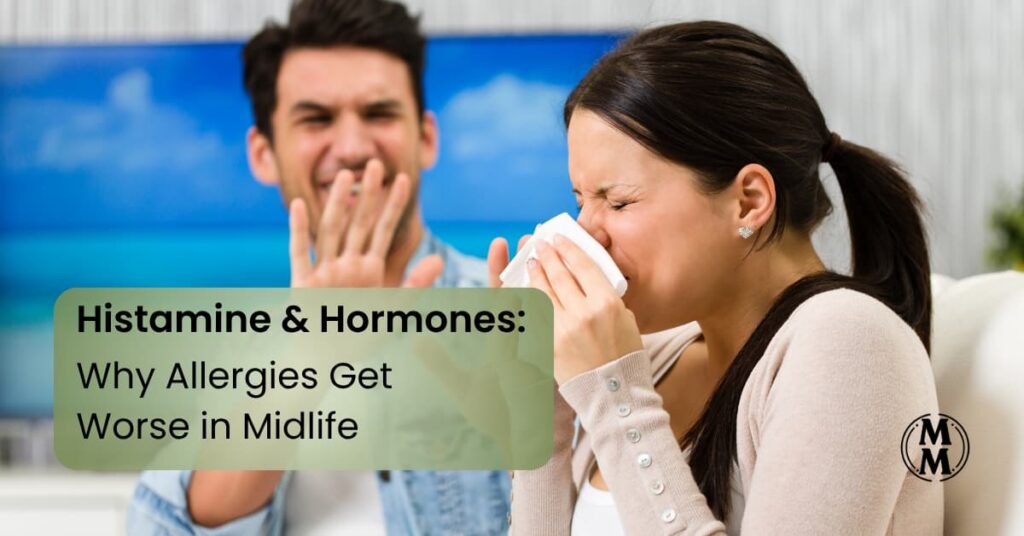
Histamine & Hormones:
Why Allergies Get Worse in Midlife
🗂️ Hormone Health |
Gut Health
📅 April 13, 2026
🏷️ Histamine Intolerance | Allergies
Quick Hormone Takeaways
- Quick Hormone Takeaways
- “Where the Hell Did These Allergies Come From?”
- When Your Body Starts Reacting Differently — It’s Not Random
- This Isn’t About “New Allergies” — It’s About Loss of Buffer
- What Histamine Actually Does (So This Makes Sense)
- The Hormone Shift That Changes Everything
- Why Gut Health Determines How This Shows Up for You
- DAO: The Enzyme That Determines Your Food Tolerance
- When the Gut Barrier Is Compromised, the System Gets Loud
- Why It Feels Inconsistent (And Makes You Question Yourself)
- The Shift That Actually Helps
- Why This Matters Beyond “Allergies”
- Where This Fits in Your Moxie Map
- Coach’s Corner
- Wrapping It Up
- Referenced Studies & Sources
“Where the Hell Did These Allergies Come From?”
I said it out loud more than once:
“Thank God I didn’t have this when I was a kid. I would have been a miserable child to bear.”
Because this didn’t ease in. It showed up like it had always been there — except it hadn’t. I’d always had this quiet gratitude for “not having allergies,” so when these showed up, I was perplexed… and not amused. Which, of course, sent me straight into Sherlock mode.
All of a sudden, I’m reacting to things that never bothered me before. My skin is more sensitive. My nose runs when nothing obvious has changed. Foods I’ve eaten for years suddenly feel like they come with consequences.
At some point, you stop brushing it off and start asking a more serious question:
“What is going on with my body?”
Maybe even:
“Am I losing it?”
You’re not. I felt batshit crazy too.
What you’re experiencing is a shift in how your body is handling histamine — and for the first time, you’re actually feeling the edges of a system that used to operate quietly in the background. This is often referred to as histamine intolerance — but that term doesn’t fully explain what’s happening.
When Your Body Starts Reacting Differently — It’s Not Random
There’s a point in midlife where things that used to feel neutral… don’t.
A glass of wine leaves you flushed. Leftovers sit heavier than they used to. Your skin reacts faster. Your nose runs when nothing obvious has changed. You start wondering if you’ve suddenly developed allergies or if your body is just becoming more sensitive with age.
But what’s actually happening is more specific than that.
Your body isn’t becoming fragile. It’s becoming less buffered, and that exposes systems that were always there, quietly doing their job without drawing attention to themselves. Histamine is one of those systems, and when hormone shifts begin to influence it, the effects can feel confusing and unpredictable — until you understand the mechanics.
This is not about “new allergies.”
It’s about how your body is handling histamine now versus how it used to.
This Isn’t About “New Allergies” — It’s About Loss of Buffer
Histamine is not new. Your exposure isn’t new. Your body has always produced and managed it.
What’s changed is your buffer.
For years, your system had enough stability to release histamine when needed, break it down efficiently, and keep you below the level where symptoms show up.
Midlife changes that.
Not because your body is failing — but because it’s no longer absorbing the same load without feedback.
That’s why this feels sudden.
It’s not new.
It’s unmasked.
What Histamine Actually Does (So This Makes Sense)
Histamine is a signaling molecule. That’s the cleanest way to understand it.
It helps your body respond to perceived threats, produce stomach acid for digestion, regulate aspects of brain function like alertness, and communicate within both the immune and hormonal systems.
You need it.
The problem only shows up when the system responsible for regulating and clearing histamine can’t keep pace with the amount being released.
That’s when you start to feel it — not as one isolated symptom, but as a pattern: reactivity, sensitivity, and unpredictability that doesn’t seem to follow clear rules until you understand what’s underneath it.
The Hormone Shift That Changes Everything
Midlife is often described as “hormones shifting,” but that doesn’t explain anything unless we make it concrete.
Estrogen and histamine are closely connected. Estrogen can increase the release of histamine and make certain immune cells — called mast cells — more reactive.
Mast cells are part of your immune defense. They sit in tissues like your skin, gut, and airways, and when they detect something the body perceives as a threat, they release histamine as a signal.
That process is useful when it’s controlled. But when estrogen is fluctuating — which it does in midlife — those cells can become more sensitive and more easily triggered.
At the same time, progesterone — which has a stabilizing, calming effect on that system — tends to decline earlier. That means the buffering system that once kept histamine responses in check is no longer as reliable.
So now you have more histamine being released and less control over how easily it’s triggered.
That combination reduces your margin.
Things you used to tolerate without noticing?
You notice now.
You’re not developing random allergies —
~ Coach Joni
you’re losing the buffer that used to keep them quiet.
Why Gut Health Determines How This Shows Up for You
This is where things stop feeling random and start making sense.
Because histamine is not just about how much is released — it’s about how well your body can break it down and clear it.
And that happens largely in the gut.
Your microbiome — the collection of bacteria living in your digestive system — plays an active role in histamine metabolism. Some bacteria help degrade histamine, while others produce it.
When that system is balanced, histamine is handled efficiently.
When it’s not, you may be producing more histamine internally while also losing some of your ability to clear it.
That alone lowers your tolerance.
But the more critical piece sits in the lining of the gut itself.
DAO: The Enzyme That Determines Your Food Tolerance
Your body uses an enzyme called diamine oxidase (DAO) to break down histamine from food.
DAO is produced in the intestinal lining.
That detail matters.
Because if the gut lining is compromised — even mildly — DAO production can decrease. When that happens, histamine from food is not cleared efficiently. It remains active longer and contributes to symptoms that feel out of proportion to what you ate.
This explains why the same meal can feel fine one day and not fine the next.
Your intake didn’t change.
Your capacity did.
When the Gut Barrier Is Compromised, the System Gets Loud
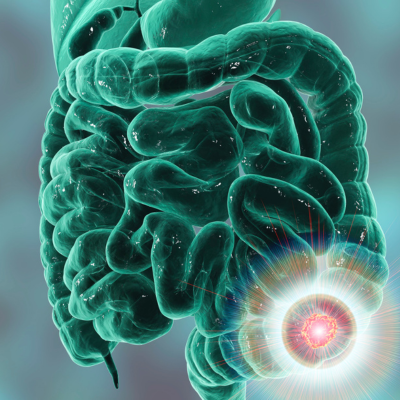
The gut lining is not just about digestion — it’s also a barrier that regulates what passes into the bloodstream.
When that barrier is weakened, more substances cross into circulation than the body is prepared to handle at once.
The immune system responds accordingly, and part of that response includes increased histamine signaling.
So, what feels like a food reaction is often not about the food alone — it’s about the state of the system processing it.
Why It Feels Inconsistent (And Makes You Question Yourself)
This is the part that makes people feel like they’re imagining things.
Because it doesn’t behave predictably.
You can eat the same thing on two different days and have completely different experiences.
That’s not random.
Histamine operates on a threshold model — what I’d call a threshold signal, where your total load exceeds your current capacity. Your body can manage a certain total load at any given time — influenced by hormones, stress, sleep, gut function, and cumulative inputs.
When that load stays within your capacity, you feel normal.
When it exceeds it, symptoms show up.
The outcome changes not because the food changed — but because the context changed.
The Shift That Actually Helps
If you reduce this to a list of “bad foods,” you’ll stay stuck.
Because the food isn’t the whole story.
The real shift happens when you start asking:
“What is affecting my ability to handle this?”
That question moves you out of reaction and into understanding.
And from there, into actual change.
Because this isn’t about eliminating histamine from your life.
It’s about restoring your body’s ability to manage it without tipping over.
Not perfectly.
But consistently.
Why This Matters Beyond “Allergies”
Histamine doesn’t operate in isolation. It influences digestion, inflammation, hormone signaling, and nervous system activity.
So, when this system is overloaded, it doesn’t stay contained to one symptom. It shows up as a broader sense that your body feels off — less stable, less predictable, less resilient.
And when it’s supported, you don’t just feel better in one area.
You feel more like yourself again.
Where This Fits in Your Moxie Map
This sits directly at the intersection of gut health and hormone health.
Which is why surface-level fixes don’t hold.
If you want to address the root — not just your symptoms:
➡ Start with Reset Mode (Gut Edition)
➡ Deepen your understanding with Gut Health 101: Why Everything Starts in the Gut
Because if your gut lining and DAO production aren’t supported, no amount of food swapping fixes the root.
That’s why gut support comes first.
Coach’s Corner
I really did think I was losing it for a hot minute.
Because nothing obvious had changed — but my experience sure had.
And once I understood the system, the frustration shifted. Not because everything instantly resolved — but because it finally made sense.
This isn’t your body betraying you.
It’s your body no longer buffering what it used to.
And once you understand that, you stop guessing.
You start working with it.
Wrapping It Up
If you’ve been asking:
“Where did this come from?”
Let’s reframe.
It didn’t come out of nowhere.
It came from a system that finally reached its limit —
and decided to let you know.
Not random.
Not imagined.
Not you falling apart.
Just a system that finally got your attention.
FAQ: Allergies in Midlife
1. Why am I suddenly getting allergies in midlife?
You’re not necessarily developing new allergies — your body’s tolerance for histamine is changing. Hormonal shifts, especially fluctuating estrogen and declining progesterone, can increase histamine activity while reducing your ability to regulate it. At the same time, changes in gut health can affect how efficiently histamine is broken down. The combination makes reactions more noticeable than they used to be.
2. What is histamine intolerance and how is it different from allergies?
Histamine intolerance is not the same as a true allergy. A classic allergy involves an immediate immune response to a specific trigger. Histamine intolerance, on the other hand, happens when your body has more histamine than it can process effectively. The symptoms can look similar — congestion, headaches, skin reactions — but the root issue is clearance and regulation, not an allergic reaction to a single substance.
3. Why do my symptoms come and go instead of being consistent?
Histamine operates on a threshold model, not a single-trigger model. Your body can handle a certain total load at any given time. That load is influenced by hormones, stress, sleep, gut health, and what you’ve eaten throughout the day. When you stay under your threshold, you feel fine. When you exceed it, symptoms show up. That’s why the same food can feel completely different from one day to the next.
4. How do hormones affect histamine levels?
Estrogen can increase histamine release and make immune cells more reactive, while progesterone helps stabilize that response. In midlife, estrogen becomes more unpredictable and progesterone tends to decline. This creates a situation where histamine is released more easily and regulated less effectively, which can increase sensitivity and reactivity.
5. What does gut health have to do with histamine intolerance?
Your gut plays a central role in how histamine is processed. Certain gut bacteria help break histamine down, while others produce it. In addition, an enzyme called DAO (diamine oxidase), which helps clear histamine from food, is produced in the intestinal lining. If the gut is imbalanced or the lining is compromised, your ability to break down histamine decreases — and symptoms are more likely to appear.
6. What is DAO and why does it matter?
DAO (diamine oxidase) is one of the main enzymes that helps break down histamine from food. Because it’s produced in the gut lining, digestive irritation or gut imbalance can reduce how well you clear histamine — which is one reason foods that used to feel fine may suddenly feel like a problem.
7. Do I need to follow a low-histamine diet forever?
Usually not. A low-histamine approach can be useful short-term to calm symptoms and spot patterns, but the long game is improving your capacity — not living on an ever-shrinking food list.
8. What are common symptoms of histamine intolerance?
Symptoms can vary, but often include:
• headaches or migraines
• flushing or skin sensitivity
• nasal congestion or post-nasal drip
• digestive discomfort or bloating
• anxiety, heart palpitations, or feeling “wired”
The key pattern is that symptoms often seem inconsistent or unrelated until you understand the underlying histamine load.
9. Can stress really make histamine symptoms worse?
Yes. Chronic stress affects gut health, weakens the intestinal barrier, and can increase histamine release. Even if your diet hasn’t changed, increased stress can lower your tolerance and make symptoms more noticeable.
10. How do I start improving histamine tolerance naturally?
Start by supporting the systems that regulate histamine:
• improve gut health and digestion
• reduce overall stress load
• prioritize sleep and recovery
• pay attention to patterns rather than single triggers
If you want a structured starting point:
👉 Reset your gut foundation (Reset Mode)
👉 Understand how your gut drives everything (Gut Health 101)
Referenced Studies & Sources
| Title | Link |
| Histamine Intolerance: The Current State of the Art | https://pubmed.ncbi.nlm.nih.gov/32824107/ |
| Histamine Intolerance Originates in the Gut | https://pubmed.ncbi.nlm.nih.gov/33921522/ |
| Histamine-producing bacteria and their role in gastrointestinal disorders | https://pubmed.ncbi.nlm.nih.gov/37394958/ |
| Immune regulation by histamine and histamine-secreting bacteria | https://pubmed.ncbi.nlm.nih.gov/28923468/ |
| Estrogen effects in allergy and asthma | https://pubmed.ncbi.nlm.nih.gov/23090385/ |
| Gender difference, sex hormones, and immediate type hypersensitivity reactions | https://pubmed.ncbi.nlm.nih.gov/18925878/ |
| Mucosal permeability and immune activation as potential therapeutic targets of probiotics in irritable bowel syndrome | https://pubmed.ncbi.nlm.nih.gov/22955358/ |
| Diamine oxidase: an overview of historical, biochemical and functional aspects | https://pubmed.ncbi.nlm.nih.gov/8200121/ |