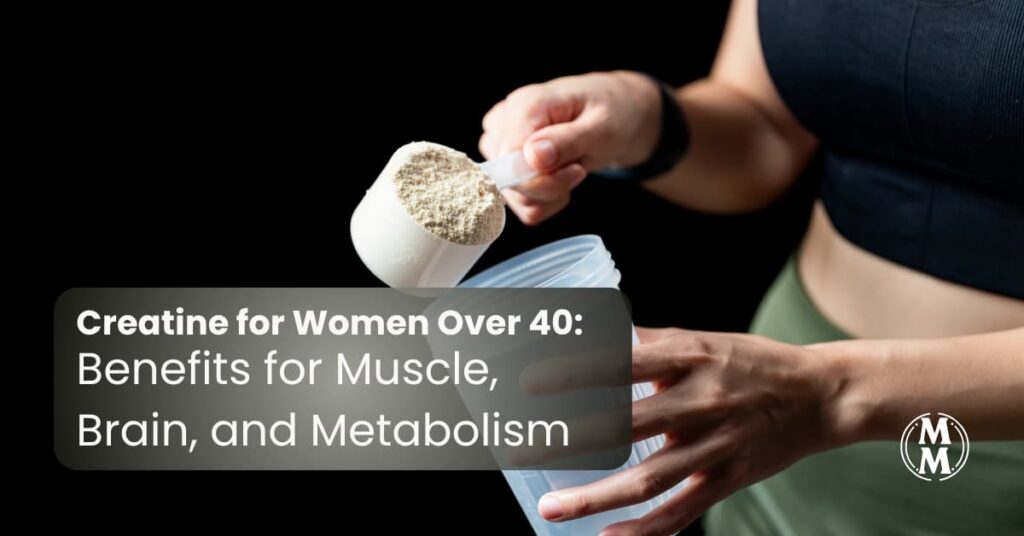
Creatine for Women
Over 40:
Benefits for Muscle, Brain, and Metabolism
🗂️ Longevity & Aging
📅 April 20, 2026
🏷️ Metabolism | Supplements
Quick Longevity Takeaways
- Creatine for Women Over 40:
- Quick Longevity Takeaways
- Why Creatine Is Suddenly Showing Up in Women’s Longevity Conversations
- Who Might Benefit Most
- What to Expect (Realistic, Not Hype)
- Why This Matters More Than You Think
- Wrapping It Up
- Smart Cart. Clean Start.
- Clean Eating
- Gut Health
- Hormone Health
- Mood & Mind
- Longevity
- Reinvention
Somewhere along the way, creatine got boxed into a very small, very sweaty corner of the internet.
Muscle guys. Pre-workout shakes. Heavy lifting. Not exactly your lane, right?
But here’s what most women don’t realize:
Creatine isn’t just about muscle.
It’s about cellular energy.
And after 40… energy becomes everything.
Because when your body starts shifting — hormones, metabolism, recovery, brain clarity — it’s not just about “getting older.”
It’s about how efficiently your cells are producing energy.
And that’s where creatine quietly steps in like the unsung hero no one told you about.
Creatine isn’t a muscle supplement — it’s an energy system upgrade.
Why Creatine Is Suddenly Showing Up in Women’s Longevity Conversations
For years, creatine lived in the world of bodybuilding and sports performance. But that framing missed the bigger picture.
What’s changed is not creatine itself — it’s our understanding of the body.
We now know that creatine plays a role in:
- cellular energy production
- muscle preservation
- brain function
- metabolic health
And as more women move into midlife asking better questions — not “How do I look?” but “How do I function?” — creatine has started to re-enter the conversation.
This isn’t a trend. It’s a reclassification.
What Creatine Actually Does in the Body
(Without the Gym Bro Filter)
ATP, Mitochondria, and Why Energy Feels Different After 40
Every cell in your body runs on a molecule called ATP — your body’s actual energy currency.
Your mitochondria (the little power plants inside your cells) produce that energy.
Creatine works by helping your body rapidly regenerate ATP, especially during times of high demand.
That matters in more places than you think:
- your muscles when you move
- your brain when you think
- your cells when they repair
When this system slows down — and it does with age — you don’t just feel “a little tired.”
You feel:
- slower to recover
- mentally drained
- less resilient overall
This isn’t just fatigue. It’s an energy production issue.
Creatine Isn’t Just for Gym Bros —
~ Coach Joni
It Might Be One of the Smartest Longevity Tools for Women Over 40
Muscle Preservation After 40 (And Why This Is Non-Negotiable)
Let’s get something straight. This is not about getting “toned” for the beach. This is about having something left in the tank when life hits. Muscle is not just aesthetic — it is metabolic and functional insurance.
As we age, we naturally lose muscle mass (a process called sarcopenia), and that loss accelerates if we’re not actively maintaining it.
And here’s the part people don’t think about:
When you get sick, injured, or hospitalized — your body pulls from muscle first.
Fast.
What you have going into that moment matters.
I watched this play out with Jerry.
After his surgeries, his body had been through hell. He was down to about 120 pounds on a 5’11” frame. The assumption was that he wouldn’t be able to move well on his own.
But his core strength told a different story.
Even in that depleted state, he had something to work with — and it made a difference. A real one. That’s what we’re talking about here. This isn’t about getting bigger — it’s about not getting weaker.
Creatine supports this by helping improve strength output and preserve lean mass — especially when paired with even modest resistance or movement.
Muscle isn’t about how you look in a mirror — it’s about what your body can do when you need it most.
Creatine and Brain Energy — The Piece No One Talks About
Your brain is one of the most energy-demanding organs in your body.
It burns through ATP constantly — to think, focus, regulate mood, and process information. Let me say that again for those in the back… regulate mood.
Creatine helps support that energy system in the brain, just like it does in muscle.
What that can translate to in real life:
- better mental stamina
- reduced cognitive fatigue
- clearer thinking under stress
- ability to handle overwhelm
- emotional regulation under load
Because midlife women don’t just want “focus”.
They want to not feel fried by 2pm.
And let’s say this out loud:
If your brain feels tired all the time, that’s not a motivation problem —
it may be an energy problem.
For women navigating midlife — juggling responsibilities, stress, and hormonal shifts — this piece matters more than most people realize.
Metabolism, Blood Sugar, and Energy Stability
This is an area where the science is still evolving — but what we’re seeing is worth paying attention to.
Emerging research suggests creatine may support:
- improved glucose handling
- enhanced insulin sensitivity (especially when combined with exercise)
It’s not a magic metabolic fix. But it appears to support the systems that help regulate energy more efficiently. And when your energy systems run better, everything downstream benefits.
This is where science is still unfolding — and where curiosity, not hype, serves you best.
Common Myths About Creatine (Let’s Clean This Up)
Myth: Creatine Makes You Bulky
Creatine does not build muscle on its own.
It supports your ability to perform and recover — which can help maintain or gradually build lean muscle when paired with resistance training.
Women do not suddenly “bulk up” from creatine. That’s not how female physiology works.
What most women notice instead is improved strength and a bit more firmness over time.
Myth: Creatine Causes Unhealthy Water Retention
Creatine can increase water content inside muscle cells — which is actually part of how it supports performance and recovery.
This is not the same as feeling puffy or bloated.
For most women, this shows up as hydrated muscle tissue, not visible swelling.
Myth: Creatine Is Hard on the Kidneys
In healthy individuals, standard doses of creatine have consistently been shown to be safe.
However, this matters:
If someone has pre-existing kidney disease or specific medical conditions, supplementation should be discussed with a qualified provider.
This is not about fear — it’s about using tools appropriately.
Myth: Women Don’t Need Creatine
Women may actually benefit significantly from creatine — especially in midlife.
Between hormonal shifts, muscle loss, and increased cognitive demands, supporting energy systems becomes more important, not less.
Who Might Benefit Most
Creatine isn’t just for athletes.
This tends to matter most for women who are starting to notice the shift — fatigue creeping in, recovery slowing down, or strength not feeling as reliable as it used to.
It may be especially helpful for:
- women in their 30s, 40s, and beyond
- those experiencing fatigue or slower recovery
- beginners starting strength training
- women noticing brain fog or mental fatigue
- anyone looking to preserve strength and resilience over time
The goal is not perfection.
The goal is support.
How to Use Creatine (Without Overcomplicating It)
Let’s keep this simple.
The form that consistently delivers results is:
👉 Creatine monohydrate
It’s the most studied, most reliable option — without the added noise.
Look for a product that is:
- third-party tested (NSF, Creapure, etc.)
- free of unnecessary fillers or flavoring
You don’t need blends, gummies, or anything dressed up like a treat.
This is a utility tool, not a novelty product.
For most women:
- 3–5 grams per day is sufficient
- no loading phase is needed
- timing matters far less than consistency
Take it in whatever way fits your routine — water, coffee, or a smoothie all work.
The goal isn’t optimization.
It’s consistency.
Safety, Hydration, and Real-Life Use
More is not better.
Stick to standard dosing.
This has been studied extensively — we’re not guessing here.
Drink enough water — not obsessively, just appropriately.
And if you have:
- kidney disease
- are on certain medications
- or have a complex medical history
…this is where a quick check-in with your provider makes sense.
This is about support, not overdoing it.
What to Expect (Realistic, Not Hype)
Creatine is not a stimulant. You won’t “feel it” the way you would caffeine.
What you may notice over time:
- improved strength
- better recovery
- more stable energy
- subtle mental clarity
It’s quiet support — not fireworks.
Why This Matters More Than You Think
This isn’t about chasing youth. And it’s not about living forever.
That’s not your call.
What is in your hands is how you feel while you’re here.
Your strength.
Your clarity.
Your ability to get up, move, think, recover, and live your life.
Muscle is not vanity — it’s independence.
Brain energy is not optional — it’s how you show up.
Cellular energy is not abstract — it’s everything.
This isn’t about optimizing your body
— it’s about protecting your life inside it.
You’re not trying to win longevity.
You’re trying to wake up with energy, think clearly, move without fear, and not feel like your body is quietly betraying you.
Wrapping It Up
You don’t need every supplement under the sun.
You don’t need hype.
You need tools that actually support how your body works — and how you want to feel living inside it.
Creatine might be one of those tools.
And now?
You get to decide — eyes wide open.
Smart Cart. Clean Start.
Download your free guide to shop cleaner, label smarter, & set yourself up for clean eating success — without the overwhelm.
Creatine FAQ: What You Need to Know
1. Is creatine safe for women over 40?
Yes, for healthy individuals at standard doses, creatine is well-supported in the research as safe. Those with kidney conditions should consult a provider.
2. Will creatine make me gain weight?
Some people may notice a slight increase due to water stored in muscle — not fat gain. Many women notice improved strength rather than visible size changes.
3. Do I need to work out for creatine to help?
It works best when paired with movement, but it still supports cellular energy and brain function regardless.
4. Can creatine help with brain fog?
It may support mental energy and cognitive performance, particularly under stress or fatigue.
5. How long before I notice results?
Some people notice subtle changes within a few weeks, especially in strength and recovery. Cognitive benefits may be more gradual.
Referenced Studies & Sources
| Title | Link |
|---|---|
| International Society Of Sports Nutrition Position Stand: Safety And Efficacy Of Creatine Supplementation In Exercise, Sport, And Medicine | https://pubmed.ncbi.nlm.nih.gov/28615996/ |
| Creatine Supplementation And Cognitive Performance: A Systematic Review | https://pubmed.ncbi.nlm.nih.gov/29704637/ |
| Creatine Supplementation During Resistance Training In Older Adults—A Meta-Analysis | https://pubmed.ncbi.nlm.nih.gov/21311353/ |
| Effects Of Creatine Supplementation On Glucose Metabolism And Insulin Sensitivity In Humans | https://pubmed.ncbi.nlm.nih.gov/20386132/ |
| Creatine Supplementation Improves Brain Performance: A Double-Blind, Placebo-Controlled, Cross-Over Trial | https://pubmed.ncbi.nlm.nih.gov/14561278/ |
| Effects of Creatine Supplementation on Brain Function and Health | https://pubmed.ncbi.nlm.nih.gov/35267907/ |
Explore by Pillar

Clean Eating
Build a clean foundation without the overwhelm.

Gut Health
Banish bloat, balance bugs, & get your rhythm back. Fast!

Hormone Health
Decode midlife shifts & feel like yourself again.

Mood & Mind
From spirals to steady — regulate with grit & grace.

Longevity
Age-defying habits for women who still want to glow.

Reinvention
You’re not done — you’re just getting started. Buckle Up!