
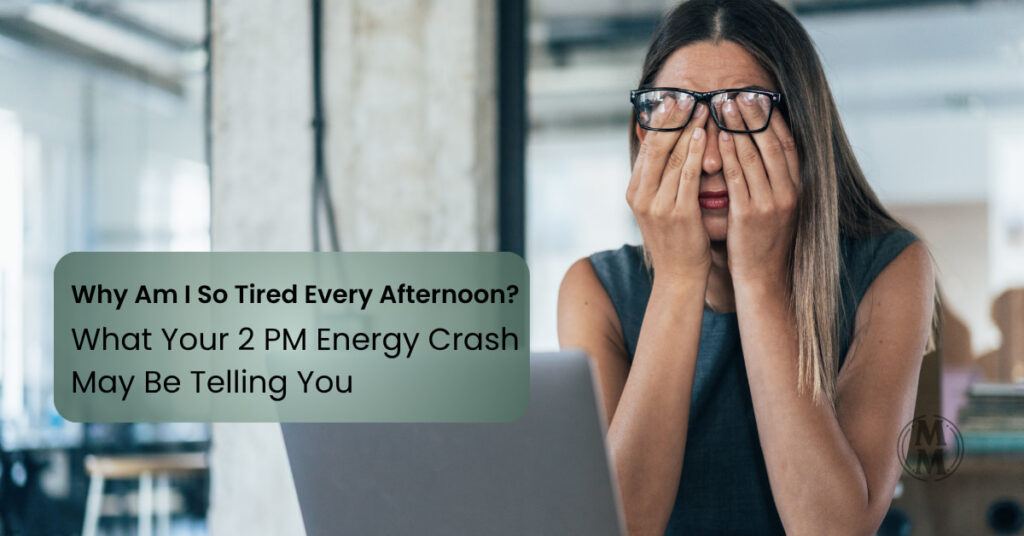
Why Am I So Tired Every Afternoon?
What Your 2 PM Energy Crash May Be Telling You
🗂️ Mindfulness & Mood | Hormone Health | Longevity & Aging
📅 June 9, 2026
🏷️ Energy | Fatigue | Stress
I’ve been noticing something lately.
Not just in myself, but in other women too.
It usually shows up somewhere between one and three o’clock in the afternoon.
A woman who felt perfectly capable all morning suddenly finds herself staring at her computer screen, wandering into the kitchen for the third time, wondering why she’s craving something sweet, or fantasizing about crawling under a blanket for twenty minutes and pretending the rest of the day doesn’t exist.
Sometimes she reaches for coffee.
Sometimes chocolate.
Sometimes she starts mentally beating herself up.
Maybe I need more discipline.
Maybe I need to get moving.
Maybe I’m just being lazy.
And that last one is the one that bothers me.
Because after years of watching women navigate stress, caregiving, hormones, aging, work, relationships, grief, overwhelm, and the thousand invisible responsibilities that somehow end up on our plates, I have become increasingly convinced that most women are not nearly as lazy as they think they are.
Exhausted? Sometimes.
Overloaded? Frequently.
Running on fumes while pretending they’re fine? More often than they’ll admit.
But lazy?
Not usually.
Which is why I’ve started paying closer attention whenever I hear a woman describe her afternoon energy crash as some sort of personal failure.
Because what if the crash isn’t a character flaw? What if it’s communication? What if the body is doing what it has been trying to do all along—getting our attention?
One of the biggest ideas we’ll explore is that the body speaks differently than we do.
It doesn’t sit us down at the kitchen table and politely explain that our stress levels have been climbing for six months, our sleep has been inconsistent, we’re surviving on caffeine and determination, and we’ve quietly accumulated more responsibilities than our nervous system knows what to do with.
Instead, it speaks in sensations.
In symptoms.
In patterns.
In nudges.
In whispers that become louder when we ignore them. And eventually, if necessary, in what feels like a full-blown protest.

The funny thing is that most of us understand this concept perfectly well when it comes to almost everything except ourselves.
If the check engine light comes on in your car, you don’t immediately assume the vehicle is morally deficient.
You don’t accuse it of lacking motivation. You don’t tell it to develop a better attitude. You simply understand that a system is communicating information.
Yet somehow, when our own bodies start sending signals, many of us jump straight to judgment.
I should be doing better.
I should have more energy.
I should be able to push through this.
I should.
I should.
I should.
And somewhere in all that self-criticism, we miss the more useful question.
What is this trying to tell me?
That question changed a lot for me.
Not overnight.
Not in some dramatic, lightning-bolt moment.
More like slowly, over time, as I started noticing that many of the things I thought were random actually weren’t random at all.
The afternoon crashes.
The periods of brain fog.
The days when everything felt harder than it should.
The times I found myself craving sugar even though I knew better.
The mornings I woke up tired after a full night’s sleep.
At first they seemed disconnected. Like unrelated annoyances. But eventually I started seeing something else.
Patterns.
And once you start seeing patterns, it’s very difficult to go back to seeing isolated events.
That’s because patterns tell stories. A single afternoon crash might not mean much. Five crashes a week starts becoming interesting.
A crash after every poor night’s sleep becomes information.
A crash after a stressful week becomes information.
A crash that shows up whenever breakfast consists of coffee and good intentions becomes information.
Suddenly you’re no longer looking at a random symptom.
You’re looking at a conversation.
And that’s where things get interesting.
Because the goal isn’t to become obsessed with every sensation that passes through your body. The goal isn’t to spend your life analyzing every headache, every craving, every ache and pain. The goal is simply to become a better observer.
To get curious.
To recognize that your body may be keeping track of things you haven’t been paying attention to.
And if that’s true, then maybe a 2 PM crash isn’t the story at all.
Maybe it’s the clue.
If fatigue is the dashboard light, what are the systems under the hood that might be causing that light to come on?
Dashboard Area #1: Sleep
Have you ever noticed how your body is willing to negotiate for a day or two?
You can stay up too late.
Wake up too early.
Push through a stressful week.
Drink a little extra coffee.
And for a while, everything appears fine.
Then somewhere around Thursday afternoon your body presents the bill. The fascinating thing about fatigue is that it’s often delayed. The crash you’re experiencing today may have very little to do with today at all. It may be the accumulation of several nights of mediocre sleep finally catching up with you.
And because the body is wonderfully inconvenient, it rarely sends an invoice labeled “sleep debt.”
It simply turns down the energy.
What to watch for:
Does your afternoon crash happen more often after several restless nights, even if those nights didn’t seem terrible at the time?
Dashboard Area #2: Fuel
One of the most surprising things I learned about energy is that the body is far less interested in our intentions than it is in our inputs.
You can intend to eat better.
You can intend to have a balanced lunch.
You can intend to stop surviving on coffee and whatever happens to be within arm’s reach at noon.
The body appreciates the effort.
But it still has to work with what actually showed up.
I started noticing this years ago when I would have mornings that felt productive enough. Nothing seemed terribly wrong. I was getting things done. Crossing things off the list. Moving through the day.
Then two o’clock would arrive and suddenly I was standing in the pantry looking for something sweet.
Not because I lacked willpower.
Not because I had become a different person since breakfast.
Because my body was looking for fuel.
Sometimes breakfast had been too small. Sometimes lunch had been rushed.
Sometimes protein had quietly disappeared from the day altogether. And sometimes coffee had been doing far more heavy lifting than I wanted to admit.
What fascinated me was realizing that the craving itself wasn’t the problem.
The craving was the message.
The body was trying to solve something.
Once I started looking at cravings as information rather than evidence of failure, they became much easier to understand.
What to watch for:
Do your afternoon crashes tend to happen on days when meals are rushed, skipped, heavily processed, or built mostly around carbohydrates?
The answer doesn’t need to be perfect.
It just needs to be honest.
Dashboard Area #3: Stress
This may be the sneakiest signal of them all because stress is a master of disguise.
In fact, some of the most stressed women I know don’t feel tired at first.
They feel productive.
Focused.
Capable.
Almost superhuman.
They become the women everyone relies on because they’re the women who can handle everything.
Until suddenly they can’t.
One of the great misunderstandings about stress is that we often mistake adrenaline for energy.
For a season, the body can borrow from tomorrow to get through today. It can flood the system with stress hormones and help us power through difficult circumstances.
A sick spouse.
A struggling child.
A demanding job.
A move.
Financial pressure.
Grief.
Life.
The problem is that borrowed energy eventually comes due. And when it does, the body doesn’t always send a formal notice. Sometimes it simply starts pulling the plug on the extra power supply.
What to watch for:
Do your crashes happen during periods when life feels emotionally heavy, even if you’re managing it well on the surface?
Because handling stress and being unaffected by stress are not the same thing.
Dashboard Area #4: Hydration
This one sounds almost too simple, which is probably why so many of us overlook it.
The body is remarkably adaptable. It can function in a slightly dehydrated state for quite a while. The problem is that functioning and thriving are not the same thing.
Many women move through entire days drinking coffee, grabbing a few sips of water here and there, and assuming they’re hydrated because they aren’t actively thirsty.
Meanwhile the brain, circulation, digestion, and energy systems are all trying to operate with less support than they were designed to have.
What’s particularly interesting is that dehydration doesn’t always announce itself as thirst.
Sometimes it shows up as fatigue.
Sometimes brain fog.
Sometimes headaches.
Sometimes irritability.
The signal isn’t always obvious.
Which is exactly why it’s worth paying attention to.
What to watch for:
On the days when your energy feels better, what did your hydration look like?
Not what you intended to drink.
What you actually drank.
Dashboard Area #5: Recovery
This is the one I keep coming back to. Maybe because it feels like the most honest conversation. Most women understand output. We’ve been practicing output our entire lives.
We know how to show up.
Push through.
Get it done.
Take care of everyone else.
Keep moving.
What many of us never learned is recovery.
Real recovery.
Not distraction.
Not scrolling.
Not collapsing into bed completely depleted.
Recovery.
The kind that actually replenishes something.
When was the last time you recovered from anything?
A stressful season.
A caregiving season.
A loss.
Months of poor sleep.
Years of carrying too much responsibility.
The body keeps track of all of it. And sometimes an afternoon crash isn’t about what happened today. It’s about what never got recovered from yesterday.
Or last month.
Or last year.
What to watch for:
When was the last time you intentionally did something that restored you rather than simply helped you survive another day?
A Coach’s Insight About Fatigue
The women I know are not suffering from a lack of effort. If anything, effort is the one thing they have in abundance.
What they’re often missing is permission.
Permission to notice.
Permission to listen.
Permission to believe that a symptom might be information rather than evidence that they’re somehow failing.
I’ve watched women spend years fighting their bodies when what they really needed was to start paying attention to them.
Not because every symptom is a crisis. But because every signal contains information. And information is useful.
The Shift
The next time that 2 PM crash shows up, resist the urge to immediately judge yourself.
Imagine the dashboard light blinking on.
Then get curious.
Ask yourself:
What system might be trying to get my attention today?
Sleep?
Fuel?
Stress?
Hydration?
Recovery?
Because the goal isn’t to silence the signal. The goal is to understand it. And once you begin understanding it, something remarkable starts to happen.
You stop seeing your body as the enemy.
You stop viewing symptoms as betrayals.
You stop assuming every struggle is a character flaw.
Instead, you begin building something many women have lost without even realizing it.
Trust.
Not blind trust.
Not perfect trust.
Just enough trust to ask a better question.
And often, that’s where healing begins.
Ready to Go Deeper?
If you’ve started noticing connections between your energy, digestion, stress levels, cravings, and daily rhythms, you’re already doing the most important work: paying attention.
Reset Mode: Gut Edition was designed to help you continue that conversation with your body—without overwhelm, shame, or complicated protocols.
Because the goal isn’t perfection.
It’s understanding.
And understanding changes everything.
Energy Crash FAQ: What You Need to Know
Is it normal to feel tired every afternoon?
Occasional afternoon fatigue is completely normal. Our energy naturally rises and falls throughout the day. What becomes interesting is when the same crash happens repeatedly and begins affecting your focus, mood, cravings, productivity, or quality of life.
A single afternoon slump may not mean much. A recurring pattern is often worth paying attention to.
Does a 2 PM crash always mean I have blood sugar issues?
No.
Blood sugar is only one possible contributor. Sleep quality, stress load, hydration, meal composition, recovery, medications, health conditions, and even emotional overwhelm can all influence energy levels.
That’s why it’s so important not to jump to conclusions. The goal is to become curious about patterns rather than assuming there’s one explanation for every symptom.
Why do I feel exhausted even when I slept all night?
Sleep quantity and sleep quality are not always the same thing.
You can spend eight hours in bed and still wake up feeling tired if your sleep was fragmented, your stress levels were elevated, your body is recovering from illness, or your nervous system never fully settled into restorative sleep.
Sometimes the body needs more than sleep. It needs recovery.
Can stress really make me physically tired?
Absolutely.
One of the reasons stress is so confusing is that it doesn’t always feel exhausting at first. Many women experience stress as productivity, urgency, focus, or the ability to “handle everything.”
Eventually, however, the body has to account for the energy it has been spending. When that happens, fatigue often becomes one of the first signals that recovery is needed.
How do I know if my fatigue is something I should discuss with my doctor?
Persistent, worsening, or unexplained fatigue should always be discussed with a healthcare professional.
While lifestyle patterns often contribute to energy crashes, fatigue can also be associated with conditions involving thyroid function, anemia, sleep disorders, blood sugar regulation, medications, cardiovascular health, and other medical concerns.
If something feels significantly different than your normal pattern, it deserves attention.
What is the first thing I should do when I notice an afternoon crash?
Instead of immediately reaching for another cup of coffee, try becoming an observer.
Ask yourself:
How have I been sleeping lately?
What did I eat today?
How stressed have I been?
Have I been drinking enough water?
When was the last time I truly recovered from anything?
You don’t need to solve everything at once.
You simply need to start noticing.
Because awareness is often where meaningful change begins.
Referenced Studies & Sources
| Title | Link |
|---|---|
| Sleep Deprivation: Impact On Cognitive Performance | https://pubmed.ncbi.nlm.nih.gov/19300585/ |
| The Influence Of Glycemic Index On Cognitive Functioning: A Systematic Review Of The Evidence | https://pubmed.ncbi.nlm.nih.gov/24618754/ |
| Effects Of Differences In Postprandial Glycaemia On Cognitive Functions In Healthy Middle-Aged Subjects | https://pubmed.ncbi.nlm.nih.gov/17851459/ |
| The Effects Of Chronic Stress On Health: New Insights Into The Molecular Mechanisms Of Brain-Body Communication | https://pubmed.ncbi.nlm.nih.gov/28031896/ |
| Allostatic Load Biomarkers Of Chronic Stress And Impact On Health And Cognition | https://pubmed.ncbi.nlm.nih.gov/19822172/ |
| Water, Hydration, And Health | https://pubmed.ncbi.nlm.nih.gov/20646222/ |
| Mild Dehydration Affects Mood In Healthy Young Women | https://pubmed.ncbi.nlm.nih.gov/22190027/ |
| Interoception And Mental Health: A Roadmap | https://pubmed.ncbi.nlm.nih.gov/29884281/ |
Explore by Pillar

Clean Eating
Build a clean foundation without the overwhelm.

Gut Health
Banish bloat, balance bugs, & get your rhythm back. Fast!
Hormone Health
Decode midlife shifts & feel like yourself again.
Mood & Mind
From spirals to steady — regulate with grit & grace.

Longevity
Age-defying habits for women who still want to glow.

Reinvention
You’re not done — you’re just getting started. Buckle Up!