
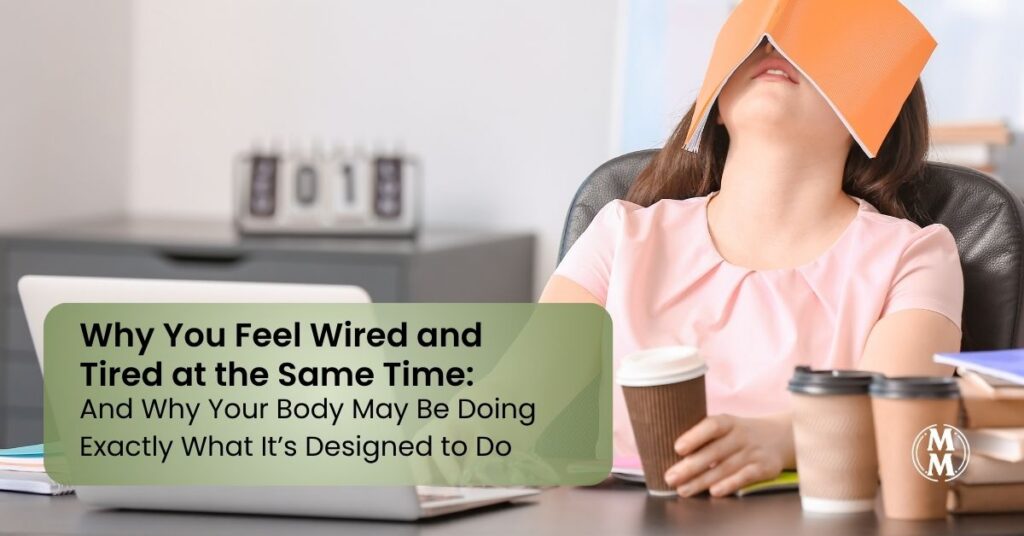
Why Am I So Tired But Can’t Relax?
Your body may not be working against you. It may be responding exactly as it was designed to.
🗂️ Hormone Health | Mood & Mindfulness
📅 June 15, 2026
🏷️ Nervous System| Body Signals
Quick Hormone Health Takeaways
- Why Am I So Tired But Can’t Relax?
- Quick Hormone Health Takeaways
- Why Am I So Tired But Can’t Relax?
- The Question That Changed How I Think About Stress
- The Signals We Send Our Bodies Every Day
- Why Caregiving Changes the Equation
- Why This Matters More Than You Think
- How to Start Sending Different Signals
- Coach’s Insight
- Wrapping It Up
- Referenced Studies & Sources
Why Am I So Tired But Can’t Relax?
Have you ever had one of those days where you’re counting down the minutes until bedtime?
You’re tired before lunch, then you hit a wall around two in the afternoon, and by dinner you’re running on fumes. Exhausting just reading that, isn’t it?
And then you finally climb into bed, pull up the covers, settle into your favorite spot, and your brain decides this is the perfect time to review every unfinished task, every future possibility, and every mistake you’ve made since approximately 1987.
It’s frustrating.
And it’s confusing.
If you’ve experienced it often enough, you may have started wondering whether something is wrong with you. I want to offer another possibility.
What if your body is doing exactly what it was designed to do?
The Question That Changed How I Think About Stress
For years, I thought stress was something that happened to us.
A difficult diagnosis.
Financial pressure.
Family conflict.
A demanding job.
A season of caregiving.
And certainly, those things create stress — lots of it. But over the last few years, I’ve started looking at it a little differently.
What if stress isn’t only about what happens to us? What if it’s also about the messages our body receives from us all day long?
That realization stopped me in my tracks.
Because I spend a lot of time helping people pay attention to the signals they’re receiving from their bodies. Fatigue. Cravings. Brain fog. Digestive issues. Poor sleep. Mood changes.
Those signals matter.
But there’s another side of the conversation.
We’re sending signals, too.
Not with words.
With our actions.
With our routines.
With the way we move through our days.
The Signals We Send Our Bodies Every Day
Think about a fairly normal day.
- You skip breakfast because you’re running behind.
- You answer emails while eating lunch.
- You switch between six different tasks before finishing one.
- You check your phone fifty times.
- You push through hunger.
- You ignore fatigue.
- You promise yourself you’ll rest later.
Then later never arrives.
None of those things seem particularly dramatic. In fact, most of us would call that a productive day.
The challenge is that your body isn’t evaluating productivity. Your body is constantly gathering information and asking a very simple question:
“Are we safe enough to relax?”
Not safe from bears. Not safe from burglars.
Safe enough to recover. Safe enough to let our guard down. Safe enough to stop scanning for the next problem that needs solving.
When the answer keeps coming back as “not yet,” the body responds accordingly.
That isn’t failure. That’s adaptation.
Your body doesn’t respond to your intentions.
~ Coach Joni
It responds to the signals you repeat.
Why Caregiving Changes the Equation
I think this is one reason so many caregivers find themselves feeling wired and tired.
When someone you love is struggling, your attention changes.
You start listening for sounds during the night.
You remember medications.
You track appointments.
You watch for symptoms.
You think ahead.
You prepare.
You become the person who keeps all the moving pieces moving.
Most caregivers don’t even realize they’re doing it because it becomes part of daily life. But your nervous system notices. Your body notices.
It recognizes that you’re carrying responsibility, uncertainty, and vigilance, even if you’re carrying them with love.
That doesn’t mean caregiving is wrong. It simply means it has a physiological cost. And understanding that cost matters because then you can adjust accordingly.
Why This Matters More Than You Think
When we think about feeling stressed, we often imagine it as an emotional issue. But the effects tend to show up everywhere.
- Sleep becomes harder.
- Energy becomes less reliable.
- Cravings become louder.
- Patience gets shorter.
- Focus becomes more difficult.
- Recovery takes longer.
Many of us try to solve each symptom individually.
A supplement for energy.
A different diet for cravings.
Another cup of coffee for fatigue.
Sometimes those things help. But sometimes the real issue is that the body has been receiving one message over and over again:
Stay alert.
Pay attention.
Don’t miss anything.
Something needs you.
When that becomes the background music of daily life, it’s not surprising that the body has trouble powering down.
How to Start Sending Different Signals
This is where I think many health conversations go off the rails. Someone tells you to “reduce stress.”
That’s lovely advice. It’s also completely unhelpful. Most of us can’t eliminate stress because life doesn’t work that way.
What we can do is begin sending different signals.
Maybe that means eating lunch before you’re ravenous.
Maybe it means sitting outside for ten minutes without your phone.
Maybe it means finishing one task before starting another.
Maybe it means taking a short walk after dinner.
Maybe it means recognizing that rest is productive when recovery is what your body needs.
None of these actions are dramatic.
That’s exactly why they work. Our nervous system responds to patterns, not grand gestures.
Read that again…
Not grand gestures. Patterns.
Coach’s Insight
One of the biggest shifts I’ve made personally is realizing that rest doesn’t begin when I finally sit down.
Rest begins when my body believes it’s safe enough to stop preparing for the next thing. And as I have proven repeatedly to myself, those are not the same thing.
You can spend an entire evening on the couch while mentally running tomorrow’s schedule, solving everyone else’s problems, and carrying responsibilities that haven’t even happened yet.
That’s not recovery.
Recovery starts when the body receives enough evidence that, at least for this moment, it can exhale.
Wrapping It Up
One of the core ideas behind the Sovereign Health Method is learning how to listen to your body with curiosity instead of frustration.
This conversation has been about recognizing signals.
The signal isn’t the problem.
The signal is information.
Feeling wired and tired may be one of the clearest examples.
Your body isn’t betraying you.
It most certainly isn’t failing you.
What it may be doing is simply responding to the messages it has received day after day, week after week, and year after year.
Once you understand that, something powerful happens. You stop fighting your body and you start working with it.
If this article resonated with you, Reset Mode: Gut Edition is a great next step. The program helps you create consistent patterns of nourishment, rhythm, and support so your body can begin receiving a different message—one that supports healing instead of constant vigilance.
Wired and Tired FAQ: What You Need to Know
Can stress really make me feel tired and alert at the same time?
Yes. Many people experience physical fatigue alongside mental alertness, especially during prolonged periods of stress or responsibility.
Why do I feel exhausted all day but awake at night?
When the body spends long periods in a heightened state of vigilance, it can be difficult to fully settle down even when you’re physically tired.
Is caregiving hard on the nervous system?
It can be. Caregiving often requires ongoing attention, planning, responsibility, and uncertainty, all of which can influence how the nervous system responds.
Can small habits really help?
Absolutely. The nervous system responds to repeated patterns. Consistent small actions often have a greater impact than occasional large efforts.
Is feeling wired and tired just part of getting older?
Not necessarily. While aging brings changes, feeling wired and tired is often a clue worth paying attention to rather than something to simply accept.
Referenced Studies & Sources
| Title | Link |
|---|---|
| Physiology and Neurobiology of Stress and Adaptation: Central Role of the Brain | https://pubmed.ncbi.nlm.nih.gov/17615391/ |
| Polyvagal Theory: A Science of Safety | https://pmc.ncbi.nlm.nih.gov/articles/PMC9131189/ |
| Stress, Adaptation, and Disease: Allostasis and Allostatic Load | https://pubmed.ncbi.nlm.nih.gov/9629234/ |
| Understanding the Impacts of Caregiver Stress | https://pubmed.ncbi.nlm.nih.gov/32453176/ |
| Neurobiological and Systemic Effects of Chronic Stress | https://pubmed.ncbi.nlm.nih.gov/28856337/ |
Explore by Pillar

Build a clean foundation without the overwhelm.

Banish bloat, balance bugs, & get your rhythm back. Fast!
Decode midlife shifts & feel like yourself again.

From spirals to steady — regulate with grit & grace.

Age-defying habits for women who still want to glow.

You’re not done — you’re just getting started. Buckle Up!