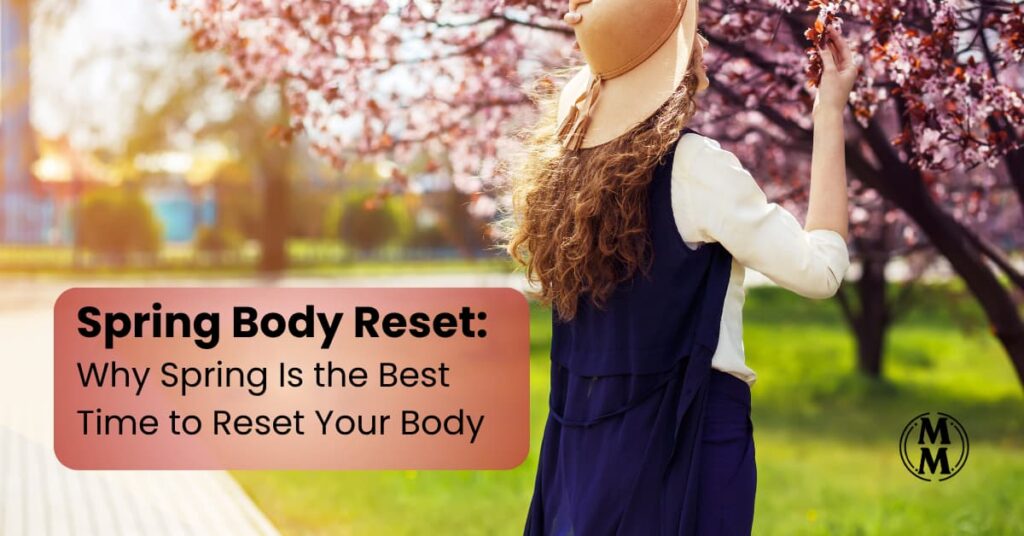
Why Spring Is the Best Time to Reset Your Body
According to Biology
🗂️ Clean Eating & Detox
📅 March 20, 2026
🏷️ Detox| Clean Eating
Spring is the ideal time to reset because:
When Spring Arrives… Your Body Knows
Winter is sneaky.
You’re bundled in sweaters. Elastic waistbands. Cozy layers. Heavier meals that feel comforting when the wind is cold and the days are short.
Then one evening in early spring, you reach for something in your closet you haven’t worn since fall.
And suddenly… reality taps you on the shoulder.
That happened to me recently. I pulled out a pair of pants for an event. I got them on — technically. But comfort? Not happening.
And this girl is all about comfort.
Winter had done its thing. Nothing dramatic. Just that quiet accumulation that happens when the season encourages us to slow down, eat heavier foods, and spend more time indoors.
I remember laughing to myself because the thought popped right into my head:
Ah. The polar bear layer.
Animals store extra fat during winter for a reason. It protects them, fuels them, carries them through the leaner months.
But here’s the thing.
Spring is here.
We don’t need the polar bear layer anymore.
And when you start letting go of that heaviness — physically and mentally — something interesting happens.
You feel lighter.
You move easier.
You want to get outside again.
Your body starts whispering:
Let’s reset.
And that instinct isn’t just psychological.
It’s biological.
Detox isn’t a product — it’s what happens when the body finally gets the support it needs.
~ Coach Joni
Humans Are Built for Seasonal Rhythms
For most of human history, our bodies lived in rhythm with the seasons.
Winter meant slowing down.
Food looked different then. Fresh produce was scarce. Meals were often built around preserved foods, grains, and calorie-dense ingredients that helped people get through cold months with limited supply.
Movement also shifted. Short daylight hours and harsh weather naturally reduced activity levels.
So winter became a season of conservation.
Spring was the opposite.
The earth woke up again. Fresh greens pushed through the soil. Days grew longer. People spent more time outside working, walking, and reconnecting with the land.
Food became lighter. Activity increased. Sunlight returned.
The body responded accordingly.
This is why so many people feel a natural urge to “clean things up” in spring. Not because a magazine told them to.
Because their biology is shifting.
You’re not imagining it.
Your body really does change with the seasons.
The Hidden Power of Spring Sunlight

One of the biggest drivers of that shift is light.
As daylight increases in spring, your circadian rhythm begins to recalibrate.
Circadian rhythms are the internal clocks that regulate nearly every system in the body — from sleep cycles to hormone release to metabolism.
When daylight increases, several important signals change:
Melatonin production adjusts, helping sleep cycles shift toward earlier mornings and more wakeful days.
- Cortisol — your body’s natural “get up and go” hormone — begins rising earlier in the day, giving many people a natural boost in morning energy.
- Serotonin signaling improves with increased sunlight exposure, which can elevate mood and motivation.
- Vitamin D production increases as skin receives more sunlight, influencing immune function and metabolic health.
These signals work together to tell the body something simple but powerful:
Winter is over.
Wake up.
Move again.
Reset.
Why Your Appetite Changes in Spring
Have you ever noticed something curious about your cravings?
In the middle of winter, a bowl of chili, a warm biscuit, or a hearty stew can feel like the most satisfying thing in the world.
But by April or May, that same meal can suddenly feel heavy.
Instead, you find yourself reaching for salads, fresh berries, grilled fish, or lighter meals that don’t weigh you down.
That shift isn’t just about willpower.
It’s about physiology.
Temperature changes, increased daylight, improved circadian alignment, and even shifts in the gut microbiome influence appetite signals.
Historically, spring introduced a completely different category of foods into the human diet.
Fresh greens appeared first — many of them bitter plants like dandelion, arugula, mustard greens, and herbs.
These plants do something interesting in the body.
They stimulate digestion.
Bitter compounds encourage bile flow from the liver and gallbladder, which helps break down fats and supports metabolic processes involved in detoxification.
In other words, the first foods of spring were naturally designed to help the body transition out of winter.
Nature knew what it was doing.
Spring and the Body’s Inflammation Reset
Winter also tends to push the body toward higher levels of inflammation.
Not because people are doing something “wrong,” but because the season itself creates certain conditions.
During winter many people experience:
- Less sunlight exposure
- Reduced movement
- More sedentary time indoors
- Heavier, calorie-dense foods
- More sugar around holidays
- Disrupted sleep rhythms
All of these factors can contribute to inflammatory signaling in the body.
Then spring arrives and the environment changes.
More daylight encourages outdoor activity. Fresh plant foods reappear in the diet. Sleep timing begins to shift earlier. People move more without even thinking about it.
The body responds.
Inflammation can begin to decrease as lifestyle patterns realign with natural biological rhythms.
This is one reason people often feel a surge of motivation in spring. Not because they suddenly developed discipline. Because their environment is helping them.
Let’s Talk About Detox (Without the Wellness Industry Nonsense)
The word detox has been dragged through the mud by marketing.
So let’s get something straight right up front.
Your body detoxes constantly.
Twenty-four hours a day. Seven days a week.
If it didn’t, we’d all be dead.
The liver processes toxins and metabolic waste. The kidneys filter the blood. The lungs release gaseous byproducts. The gut eliminates waste. The lymphatic system transports cellular debris out of tissues.
Your body is already doing the work. Detox isn’t something you “turn on.” But there’s an important piece people miss.
While the body detoxes continuously, the amount of toxic load we give it matters.
- If the food we eat is ultra-processed…
- If personal care products contain dozens of synthetic chemicals…
- If we’re constantly exposed to environmental toxins…
The body has more to process.
Real detox is not about forcing the body to cleanse itself.
It’s about removing the obstacles so those built-in systems can do their job efficiently.
Reduce the incoming toxic load. Support the body’s natural detox pathways.
That’s it.
Which is why the first line of defense isn’t a supplement protocol.
It’s your shopping cart.
Detox isn’t something you force on the body. It’s what happens when you finally stop poisoning it.

Why Spring Became the Season of Fasting
Across cultures, something remarkable shows up again and again when you look at spring traditions.
People fasted.
Not because fasting was trendy.
Because spring was a natural moment for reset.
In the Christian tradition, Lent has long been observed as a season of reflection and restraint leading up to Easter. For many believers it included fasting or simplifying the diet as a way to reconnect spiritually and physically.
In Islam, Ramadan also includes periods of fasting, emphasizing discipline, reflection, and gratitude.
Even outside formal religious traditions, many cultures practiced seasonal dietary resets in early spring.
Part of this timing was practical. Historically, winter food stores were running low while the new growing season had not yet fully arrived. Eating less simply made sense.
But there was also a biological layer.
After months of heavier winter eating, digestive systems benefit from rest. Periods without food allow the body to shift resources away from constant digestion and toward repair processes within cells.
Long before modern health culture began talking about intermittent fasting, traditional societies already understood something important:
The body occasionally benefits from pause.
Not starvation. Pause.
Spring became the natural time for that pause.
A moment to lighten the load. To shift from winter survival mode into renewal. And if you see life through a spiritual lens, there’s something even deeper here.
We are spirits walking around living in bodies that possess souls.
Stewardship of that body matters.
Not because we’re following rules.
Because this life we’ve been given deserves care.
Simple Ways to Reset Your Body This Spring
You don’t need a dramatic overhaul to begin resetting your body.
Most meaningful shifts start with simple habits.
Download It Now, Glow Later
It’s free. It’s fast. It’s how we flip the script on clean eating.
Drop your email below and get instant access to
Cart Before the Glow — Shopping Map.
👉 Let’s fill your cart like you actually care about your future self.
Start With Your Grocery Cart
Clean eating doesn’t begin in a recipe.
It begins at the store.
Focus on filling your cart with:
- Whole foods
- Fresh produce
- Quality proteins
- Minimally processed ingredients
When better food comes into the house, better choices naturally follow.
Support Your Gut
Your digestive system plays a major role in detox and metabolic health.
Foods that help support gut function include:
- Fermented vegetables
- Fiber-rich plants
- Herbs and bitter greens
When digestion improves, the rest of the body often follows.
Realign Your Circadian Rhythm
Light and timing matter.
Try simple adjustments like:
- Morning sunlight exposure
- Consistent sleep timing
- Finishing dinner earlier in the evening
These habits help the body recalibrate its internal clocks.
Reduce Inflammatory Foods
Many people see big improvements simply by reducing foods that promote inflammation.
That often includes:
- Ultra-processed foods
- Excess sugar
- Industrial seed oils
Less inflammatory load gives the body space to repair.
Consider Gentle Fasting Windows
Some people benefit from giving their digestive system a nightly break.
For example:
- Twelve to fourteen hours between dinner and breakfast.
Nothing extreme.
Just enough time for the body to rest and restore.
Wrapping It Up
Spring cleaning isn’t just about closets and garages.
It’s about biology.
When you align with seasonal rhythms, something interesting happens.
Energy improves.
Digestion gets smoother.
Inflammation often decreases.
And the heaviness of winter begins to lift.
Sometimes the reset your body wants doesn’t begin with discipline.
It begins with awareness.
Referenced Studies & Sources
| Title | Link |
|---|---|
| Effects of Light on Human Circadian Rhythms, Sleep and Mood | https://pubmed.ncbi.nlm.nih.gov/31534436/ |
| The Impact of Sleep and Circadian Disturbance on Hormones and Metabolism | https://pubmed.ncbi.nlm.nih.gov/25861266/ |
| Photoperiod and Metabolic Health: Evidence, Mechanism, and Implications | https://pubmed.ncbi.nlm.nih.gov/38160935/ |
| Sunlight and Vitamin D: A Global Perspective for Health | https://pubmed.ncbi.nlm.nih.gov/24494042/ |
| Therapeutic Potential of Targeting Intestinal Bitter Taste Receptors in Diabetes Associated With Dyslipidemia | https://pubmed.ncbi.nlm.nih.gov/34048925/ |
| Ultra-Processed Foods and Food Additives in Gut Health and Disease | Ultra-Processed Foods and Food Additives in Gut Health and Disease |
| Ultra-Processed Foods: Increasing the Risk of Inflammation and Immune Dysregulation | https://pubmed.ncbi.nlm.nih.gov/38831164/ |
| The Anti-Inflammatory Effects of Exercise: Mechanisms and Implications for the Prevention and Treatment of Disease | https://pubmed.ncbi.nlm.nih.gov/21818123/ |
| Flipping the Metabolic Switch: Understanding and Applying the Health Benefits of Fasting | https://pubmed.ncbi.nlm.nih.gov/29086496/ |
Explore by Pillar

Clean Eating
Build a clean foundation without the overwhelm.

Gut Health
Banish bloat, balance bugs, & get your rhythm back. Fast!

Hormone Health
Decode midlife shifts & feel like yourself again.
Mood & Mind
From spirals to steady — regulate with grit & grace.

Longevity
Age-defying habits for women who still want to glow.

Reinvention
You’re not done — you’re just getting started. Buckle Up!