Why You Feel Off in Midlife Even When Your Labs Are “Normal”
Midlife hormone symptoms often appear before labs change. Normal results don’t always mean optimal physiology …
🗂️ Hormone Health
📅 February 26, 2026
🏷️ Perimenopause | Hormone Testing
If You Feel “Off” but Your Labs Are Normal, Start Here:
- Why You Feel Off in Midlife Even When Your Labs Are "Normal"
- If You Feel “Off” but Your Labs Are Normal, Start Here:
- What “Normal” Actually Means
- What’s Actually Happening to Your Hormones
- Why It Feels More Intense Than It “Should”
- The Nervous System Amplifier
- Why Symptoms Appear Before Diagnosis
- When “You’re Fine” Doesn’t Feel Fine
- What You Can Do Now
- Why This Matters
- Interpreting the Shift
- FAQ: Midlife Hormone Symptoms
- Referenced Studies & Sources
You sit in the exam room trying to describe something that doesn’t have a clean name.
Nothing is catastrophic. You’re functioning. You’re showing up. But something has shifted. You’re more anxious than you used to be. Sleep feels lighter and more fragile. Your body composition is changing even though your habits haven’t dramatically changed. Your patience is thinner. Your brain feels slower in ways that are hard to explain.
Your doctor runs labs.
Everything comes back “normal.”
And now you’re left wondering whether this is simply aging, stress, or — if you’re honest — somehow your fault.
It isn’t.
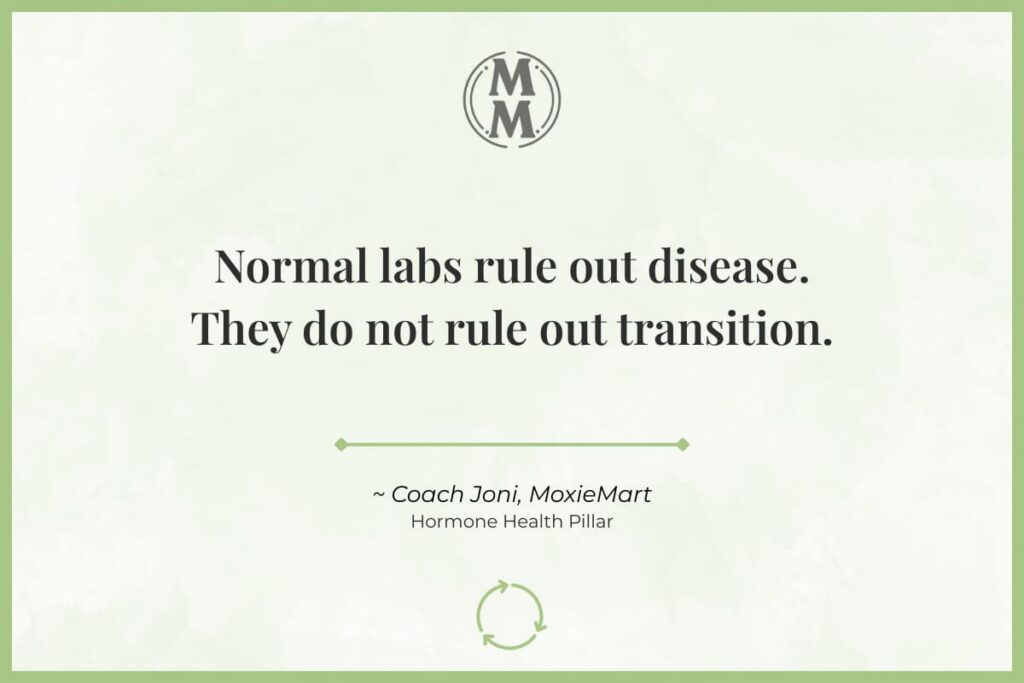
One of the most misunderstood realities of midlife hormone symptoms is that lab values are designed to detect disease, not to interpret transition. A number can sit comfortably inside a reference range while your physiology is actively recalibrating. Those are not the same thing.
Normal does not automatically mean optimal.
And midlife is rarely static.
What “Normal” Actually Means
When a lab report labels you as normal, it means your results fall within a statistical reference range derived from population averages. That population includes individuals under chronic stress, in early metabolic decline, inflamed, sleep deprived, or quietly compensating in ways that have not yet crossed a diagnostic threshold.
Medicine is structured to identify pathology. It is far less oriented toward recognizing the subtler shifts that occur before pathology develops.
Midlife is one of those shifts.
Hormones begin changing years before menopause. Stress tolerance narrows. Sleep architecture alters. Blood sugar becomes less forgiving. The body adapts quietly at first, and those adaptations often feel uncomfortable long before they look abnormal on paper.
Symptoms are frequently the early signal. Labs are often the late confirmation.
What’s Actually Happening to Your Hormones
Perimenopause does not begin the day your period stops. As I explain in Hormones in Midlife: What’s Happening to Me?, perimenopause can begin years before menopause… It often begins five to ten years earlier, sometimes even before cycles become obviously irregular.
For many women, progesterone declines first. Progesterone plays a steadying role in the body — supporting deeper sleep, modulating anxiety, and buffering stress reactivity. As progesterone decreases, estrogen does not simply glide downward in a smooth slope. It fluctuates, sometimes dramatically.
One month you may feel relatively stable. The next month you may experience heavier bleeding, breast tenderness, sudden night sweats, or mood volatility that feels unfamiliar. Fluctuation tends to produce stronger symptoms than gradual decline, which is why midlife can feel unpredictable.
A single blood draw captures one moment in that fluctuation. Your body, however, is living the entire rhythm.
Why It Feels More Intense Than It “Should”
Hormones do not operate in isolation. They influence neurotransmitters, metabolic pathways, and stress responses in ways that ripple outward.
Estrogen interacts with serotonin, affecting mood and cognition. Progesterone supports GABA, which helps regulate anxiety and nervous system calm. Both hormones influence cortisol, and cortisol in turn affects blood sugar regulation. When estrogen swings and progesterone declines, stress tolerance can narrow. Sleep becomes more fragile. Blood sugar fluctuations feel sharper.
The systems that once buffered stress begin requiring more intentional support.
This is why the wine that once felt harmless now disrupts sleep. Why skipped meals produce irritability. Why high stress lingers in your body longer than it used to.
You did not suddenly become fragile.
The buffering system changed.
The Nervous System Amplifier
One of the most overlooked contributors to midlife hormone symptoms is the nervous system itself.
Hormones are in constant conversation with the brain and stress response pathways. Estrogen modulates mood, memory, and even pain perception. Progesterone tempers excitatory brain signaling. Cortisol adjusts dynamically based on sleep, inflammation, psychological stress, and metabolic demand.
If you have spent decades running in low-grade fight-or-flight — caregiving, managing households, building careers, holding things together — midlife can reveal that accumulated strain. The hormonal cushion that once softened stress responses thins, and the same external demands now feel heavier internally.
This is not weakness. It is physiology adapting to a new season.
Why Symptoms Appear Before Diagnosis
Most diagnostic frameworks rely on thresholds. A lab value must cross a certain line before it is labeled abnormal. But biology does not operate in thresholds; it operates on gradients and adaptation.
Insulin can trend upward for years before diabetes is diagnosed. Thyroid conversion issues can develop while TSH remains technically normal. Cortisol rhythms can become dysregulated without a dramatic spike in a single morning reading. Hormones fluctuate daily and across the menstrual cycle, influenced by stress, sleep, inflammation, and nutrient status.
Symptoms often emerge during these early shifts. They are not imaginary. They are information.
Being early does not mean being broken. It means you have the opportunity to intervene before dysfunction becomes disease. And that is power.

When “You’re Fine” Doesn’t Feel Fine
Most clinicians are not dismissing women intentionally. They are working within a disease-focused model. If you do not meet criteria for a defined disorder, you are categorized as stable.
But stable is not synonymous with well.
Many women in midlife are told their experiences are simply stress or aging. And while stress and aging are part of the equation, that explanation can feel minimizing when you are the one living inside the symptoms.
Midlife hormone symptoms are not a character flaw. They are a recalibration. And recalibration requires interpretation, not dismissal.
What You Can Do Now
Before assuming something is terribly wrong, and before ignoring what your body is telling you, begin by collecting information. Notice patterns in sleep, mood, cycle changes, digestion, cravings, and energy fluctuations. Observe how alcohol affects you now. Pay attention to what happens when you skip meals or increase protein. These patterns often reveal more than a single lab value.
Then focus on stabilizing the foundations that support hormonal balance: consistent nourishment, adequate protein, blood sugar regulation, restorative sleep, nervous system regulation, and reduced inflammatory load. Midlife is less forgiving of chaos and more responsive to rhythm.
If symptoms persist or intensify, it may be appropriate to pursue deeper evaluation, including expanded thyroid panels, fasting insulin, or cycle-timed hormone testing. Not because you are broken, but because you are being thorough and proactive.
Why This Matters
This conversation is not about vanity. It is about agency.
When you feel unstable inside your own body, confidence erodes quietly. Work feels heavier. Relationships feel strained. Your sense of identity can feel unsettled.
Midlife is not a breakdown. It is a tightening of feedback loops. The behaviors and stress loads that were tolerable in your thirties may no longer be sustainable in your forties and fifties.
That is not betrayal.
It is biology asking for discernment.
When you understand the physiology behind midlife hormone symptoms, you stop internalizing them as personal failure. You begin adjusting inputs instead of questioning your sanity. You move from confusion to clarity.
And clarity restores power.
You are not imagining this shift.
You are living through it.
And when interpreted well, midlife is not the beginning of decline. It is the beginning of refinement.
Interpreting the Shift
That refinement often starts with discomfort. Hormones fluctuate. Stress tolerance narrows. Sleep becomes lighter. Metabolic flexibility tightens. None of this means you are broken. It means your physiology is recalibrating in response to a new season of life.
Laboratory ranges are useful tools, but they are not designed to translate transition. They tell you when disease is present. They do not always explain why you feel different before disease develops. That gap is where many women lose trust in themselves.
Interpreting the shift means recognizing that symptoms are information. It means understanding that progesterone decline and estrogen fluctuation can ripple into mood, sleep, and blood sugar regulation long before numbers appear abnormal. It means acknowledging that your nervous system and stress load are part of the hormonal conversation.
Most importantly, it means moving out of self-blame.
Midlife does not require panic. It requires attention. It asks for steadier rhythms, cleaner inputs, better sleep protection, and more intentional stress regulation. It rewards discernment over denial.
When you understand what is happening, you stop questioning your sanity and start adjusting your strategy.
That is not decline.
That is leadership inside your own body.
FAQ: Midlife Hormone Symptoms
Can you have midlife hormone symptoms with normal labs?
Yes. Hormone levels fluctuate daily and across the menstrual cycle. Many symptoms emerge during early hormonal shifts before levels fall outside standard laboratory reference ranges.
How early can perimenopause start?
Perimenopause can begin five to ten years before menopause. For many women, subtle hormonal changes begin in the late 30s or early 40s, even if cycles remain regular.
Why do I feel more anxious in midlife?
Estrogen influences serotonin, and progesterone supports calming neurotransmitter pathways. Fluctuations in these hormones can narrow stress tolerance and amplify anxiety, particularly when combined with sleep disruption and blood sugar instability.
If my doctor says my labs are normal, should I push for more testing?
If symptoms persist or interfere with quality of life, it may be reasonable to discuss expanded thyroid testing, fasting insulin, inflammatory markers, or cycle-timed hormone testing. The goal is not to chase pathology but to better understand physiologic patterns.
Are midlife hormone symptoms permanent?
No. Hormonal fluctuations eventually settle after menopause. With appropriate support — including sleep, blood sugar regulation, nervous system stabilization, and inflammatory reduction — many women experience significant improvement during the transition.
Ready to Stop Guessing?
If you’ve been told your labs are “normal” but your body says otherwise,
the next step isn’t panic — it’s pattern recognition.
Download the Top 10 Signs of Hormone Imbalance guide along with
the MoxieMart Hormone Tracker and start connecting your
symptoms to sleep, stress, and cycle patterns.
When your hormones are out of sync,
your body whispers before it screams.
This helps you hear it clearly.
You don’t need to fix everything today.
You need to see the rhythm clearly.
Referenced Studies & Sources
| Title | Link |
|---|---|
| Executive Summary Of The Stages Of Reproductive Aging Workshop + 10: Addressing The Unfinished Agenda Of Staging Reproductive Aging | https://pubmed.ncbi.nlm.nih.gov/22344196/ |
| Neurobiological Underpinnings Of The Estrogen–Mood Relationship | https://pmc.ncbi.nlm.nih.gov/articles/PMC3753111/ |
| Progesterone In The Brain: Hormone, Neurosteroid And Neuroprotectant | https://pmc.ncbi.nlm.nih.gov/articles/PMC7432434/ |
| Cortisol Levels During The Menopausal Transition And Early Postmenopause: Observations From The Seattle Midlife Women’s Health Study | https://pmc.ncbi.nlm.nih.gov/articles/PMC2749064/ |
| Hyperinsulinaemia: An Early Biomarker Of Metabolic Dysfunction | https://pmc.ncbi.nlm.nih.gov/articles/PMC10186728/ |
Continue to Explore by Pillar

Clean Eating
Build a clean foundation without the overwhelm.

Gut Health
Banish bloat, balance bugs, & get your rhythm back. Fast!

Hormone Health
Decode midlife shifts & feel like yourself again.

Mood & Mind
From spirals to steady — regulate with grit & grace.

Longevity
Age-defying habits for women who still want to glow.

Reinvention
You’re not done — you’re just getting started. Buckle Up!