
Somewhere along the way, wellness acquired a purity test.
You can see it in the language. Food is clean or dirty. Ingredients are good or bad. Products are safe or toxic. One person has eliminated seed oils, another has eliminated gluten, somebody else has removed dairy, sugar, alcohol, caffeine and probably anything that once made direct eye contact with a pesticide.
And I am not making fun of any of those choices. That part matters.
Some people absolutely need to avoid certain foods. Medical conditions matter. Allergies matter. Medications matter. Individual responses matter. Sometimes a fairly strict rule solves a very real problem.
The curious part begins when the rule no longer has to prove that it is helping.
You follow it because people who are “serious about their health” follow it. You feel uneasy when you break it even though you cannot quite explain what terrible thing happened. One questionable restaurant meal becomes evidence that you have fallen off the wagon. Your supplement routine begins reproducing like kudzu. Before long, you are spending an astonishing amount of time trying to make sure you are doing wellness correctly.
I noticed this years ago during my health coaching education. The more I learned, the more one part of wellness culture bothered me. We were supposedly helping people become more capable of caring for themselves, yet an awful lot of health advice seemed perfectly capable of making someone afraid of getting breakfast wrong.
It was also where I first ran into the research around orthorexia nervosa, a term used to describe a potentially pathological preoccupation with eating according to an idea of health, correctness or purity.
I remember thinking, I never want to add to that noise.
That thought stayed with me.
Caring About Your Health Is Not the Problem
This gets muddy very quickly if we are not careful, because paying attention to what you eat is not the same thing as being afraid of eating incorrectly.
Researchers have had trouble drawing that line too.
Orthorexia nervosa is not currently a formally recognized psychiatric diagnosis, and the research has been dogged by disagreements about exactly what should qualify, how it should be measured and how to distinguish a serious problem from somebody who simply cares a great deal about eating well. Some of the older screening tools were especially poor at making that distinction.
Which is rather important.
I don’t want us diagnosing ourselves because we read ingredient labels, buy organic strawberries or have opinions about grass-fed beef. There is research specifically distinguishing a healthy interest in eating well from the kind of rigid preoccupation that begins carrying emotional, cognitive or social consequences.
That makes much more sense to me.
Because caring is not what caught my attention in the first place. What caught my attention was what sometimes happens to the caring.
You learn something useful, so you make a change. Then you learn something else, so another rule appears. And another. Eventually the question quietly changes from Is this helping me? to Am I doing this correctly?
Those are not the same question.
And I think the purity trap lives somewhere in the space between them.
When a Rule Stops Having to Earn Its Keep
A useful health rule has a job.
Maybe you stop eating something because you have repeatedly noticed a symptom afterward. Maybe your physician has given you a medical reason to restrict it. Maybe you are trying a change for several weeks because there is credible evidence that it could affect something you are working on, and you have some idea what you will be watching to see whether it helped.
There is a reason. There is a question. There is something to observe.
The purity trap works differently.
At some point, following the rule itself becomes evidence that you are doing health right.
And once that happens, questioning the rule can feel strangely threatening.
You can eliminate a food, feel exactly the same and continue avoiding it for the next six years because somebody told you it was inflammatory. You can spend considerably more money on a product because the alternative contains an ingredient you have learned to fear even though you have never established that the ingredient presents a meaningful problem for you. You can find yourself turning down dinner with people you love because you cannot control which oil the restaurant uses.
None of that, by itself, diagnoses anything. Context matters far too much for that.
I am interested in the direction of travel.
Health was originally the reason for the rule.
Then, somewhere along the way, obedience became the reason for the rule.
Well, that’s curious.
Perfectionism Does Like a Nice, Clean Answer
Once I started pulling on this thread, I wondered whether perfectionism might be part of what makes the whole thing so sticky.
Apparently, researchers have wondered the same thing.
A 2024 systematic review and meta-analysis looked across the existing research on perfectionism and orthorexia and found positive relationships between several dimensions of perfectionism and orthorexic tendencies. That does not mean perfectionism causes orthorexia. The research base is still relatively small, different studies have measured orthorexia differently, and the authors themselves called for better work on the mechanisms involved.
But it does give us something worth considering.
Perfectionism is awfully comfortable with a system in which the rules appear knowable.
Do this. Never do that. Buy this version. Avoid that ingredient. Follow these twelve steps before 8:00 a.m. and perhaps your mitochondria will send you a handwritten thank-you note.
Compare that with the answer biology hands us rather often:
This may matter. It may matter more under certain circumstances. It may matter a great deal for one person and very little for another. Let’s look at what is actually happening.
Not nearly as satisfying.
Also considerably harder to put on a refrigerator magnet.
Context changes things. Dose changes things. Medical history changes things. Goals change things. Sometimes the evidence changes. Sometimes we change.
And that means anybody longing for certainty in an uncertain body is going to encounter an endless supply of people willing to sell it.
The Internet Is Extremely Helpful in This Regard
Absolute rules travel beautifully online.
Nuance has terrible thumbnails.
“Here are the circumstances in which this may matter” has to compete with “NEVER EAT THIS AGAIN,” and we all know which one the algorithm brought to the party wearing sequins.
There has been growing research interest in the relationship between social media and orthorexic tendencies, which sounds almost inevitable until you actually look at the evidence. Then it becomes more interesting.
A 2026 review gathered the existing research on orthorexia and social media and found enough of an association to justify continuing to investigate it—but also some enormous holes. There were no experimental studies, samples were limited, developmental pathways were poorly studied, and the authors were quite clear that we do not yet understand the relationship well enough to tell a tidy cause-and-effect story.
I appreciate research that knows what it doesn’t know.
So, I am not interested in declaring Instagram the villain and going home.
What interests me is the environment it creates.
The science frequently says, It depends.
The information marketplace frequently says, Absolutely.
One of those is much easier to sell.
And if you are already worried about getting your health exactly right, that is an awfully important thing to notice.
There Is Another Cost That Bothers Me More
The obvious cost of living under dozens of wellness rules is that it can become exhausting.
But I think there is another cost hiding underneath it.
You can actually become less observant while consuming more health information than ever.
That’s the part I keep coming back to.
You listen to more podcasts. Follow more experts. Save more posts. Read more studies. Learn more ingredient names. Accumulate more protocols.
Yet outside information can gradually begin replacing what you are seeing in front of you.
Someone tells you dairy is bad, so dairy becomes the explanation.
Someone tells you cortisol is the problem, and now every symptom is cortisol.
Someone declares seed oils toxic, and suddenly the oil used to sauté your vegetables is getting more investigative attention than the fact that you routinely sleep six hours a night.
The story arrives first.
Then we go looking for evidence that fits it.
That is backwards.
And it is particularly strange because one of the greatest benefits of learning about health should be that we become better at noticing. More capable of asking, Is that actually happening to me? When does it happen? What else was going on? What changed? Does this explanation account for the whole pattern?
Instead, enough rules can make us stop looking because we think we already know.
That is not the kind of health education I want.
So How Do I Know Whether a Rule Belongs?
This is where I find myself getting much more practical.
If I am going to organize part of my life around a health rule, I want the rule to be able to answer a few questions.
First, what exactly is it supposed to do?
“It’s healthier” is not much of an answer. Are we trying to change a symptom? Correct a deficiency? Control blood glucose? Avoid an allergen? Reduce a documented risk? Improve something that can actually be observed?
Then I want to know why I believe this particular change has a reasonable chance of helping with that particular problem.
Not who said it. Not how many followers they have. Not whether their kitchen contains more beige ceramic bowls than mine.
Why does this make sense?
And if I make the change, what am I looking for? Sometimes the answer will be a symptom. Sometimes it will be a laboratory marker or something a clinician is following. Sometimes I am simply conducting a reasonable little experiment in my own life and paying attention to what happens.
Finally—and wellness conversations often skip this part entirely—I want to know what the rule costs.
Money counts.
Time counts.
Nutrition counts.
Being able to eat with other people counts.
Stress counts.
Mental bandwidth certainly counts.
That does not mean an inconvenient or expensive rule is wrong. Necessary things can be inconvenient and expensive. Ask anybody who has ever needed insulin.
It means the cost belongs in the equation.
If something is genuinely helping me, perhaps the tradeoff is worth every bit of it. But if I cannot identify what the rule is accomplishing anymore, I think I am allowed to reopen the case.
That seems more useful to me than simply adding another commandment to the pantry door.
Put One Rule on Trial
Here is where I would actually do something with all of this.
Pick one wellness rule you currently live by that costs you money, time, convenience or mental bandwidth.
Not the medication your physician prescribed. Not the food you avoid because you have a diagnosed allergy or medical condition. We are not dismantling medically necessary care because a blog post left us feeling adventurous.
Pick one of the other rules.
The one you picked up from a podcast three years ago. The expensive version of something you automatically buy. The food you stopped eating because somebody somewhere called it inflammatory. The supplement that has apparently achieved lifetime tenure in your cabinet.
Write the rule down in one sentence.
I do ______ because I believe ______.
That second blank is where things often get interesting.
Now ask yourself what you expected this rule to accomplish when you adopted it. What would actually look different if it were helping? Have you ever seen that difference? Is there evidence supporting the connection, or did the rule arrive in your life attached to somebody else’s certainty?
Then look at what you are paying to keep it.
Maybe the answer is almost nothing. Fine.
Maybe you spend another $40 a month and are perfectly happy to do it because you have a clear reason. Fine again.
But perhaps you discover that you are arranging meals around a rule you cannot explain, spending money to solve a problem you do not actually have, or feeling guilty every time ordinary life makes perfect compliance impossible.
Now we have information.
From there, you do not have to declare the rule stupid and throw everything in the trash. If the reasoning still looks good but you genuinely do not know whether the practice is helping you, consider whether there is a safe way to change one variable and observe what happens.
Not twelve variables.
Not your entire diet starting Monday.
One thing.
Watch the thing the rule was supposed to affect. Keep the rest of the picture reasonably steady. Give yourself enough time to notice something meaningful for that particular question.
Then look again.
Maybe the rule earns its place.
Maybe you modify it.
Maybe you discover it has been taking up space in your life long after the original reason disappeared.
All three are useful answers.
The point was never to prove that wellness rules are foolish. The point is to make them answerable to something besides repetition.
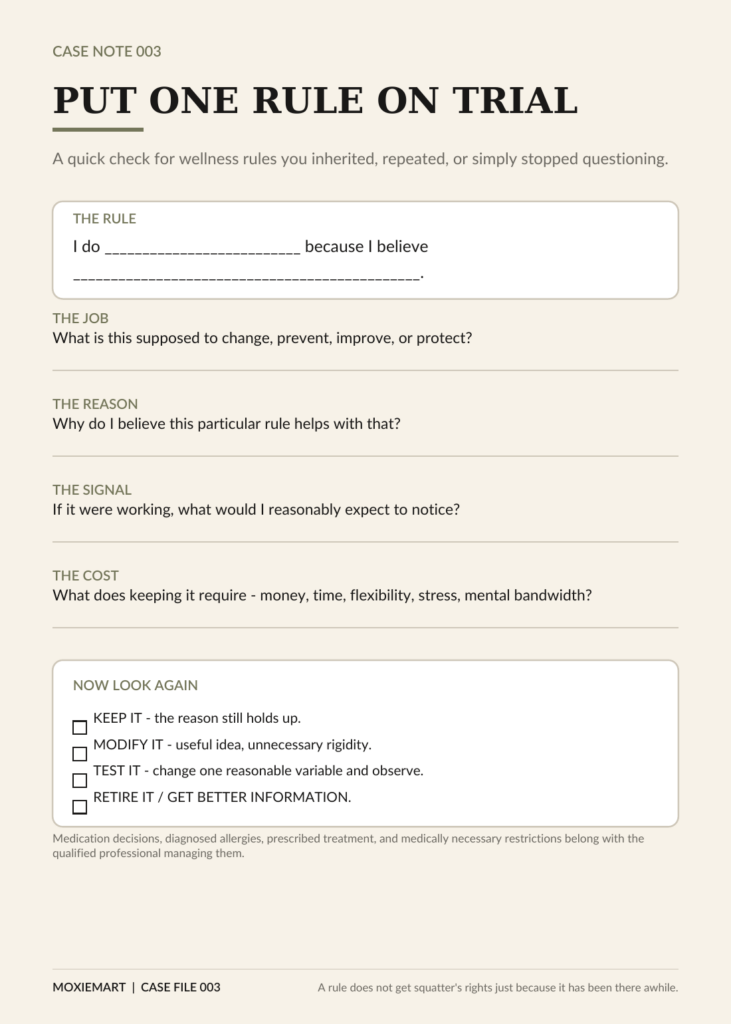
Put One Rule on Trial
You don’t need another wellness overhaul. Pick one rule and find out whether it still deserves a place in your life.
I made a simple two-sided 5×7 field card to help you examine the rule, decide what you actually know, and—if it makes sense—test one thing and watch what happens.
Two-sided 5×7 PDF • No email required
Print it, keep it on your computer, or use it the next time a wellness rule starts sounding suspiciously like a commandment.
I Am Not Arguing for Caring Less
I can already hear the objection because I have made versions of it myself.
So now we’re supposed to stop caring what we eat?
No.
That would be another ridiculous absolute rule, and apparently, we have learned nothing.
There are meaningful differences between foods. There are exposures worth reducing. There are habits with meaningful consequences for health. Some people have medical reasons to be extremely careful. Sometimes you learn something, weigh what you know and quite reasonably decide, I don’t want that anymore.
Fine.
I want that decision to belong to you.
Not to fear. Not to an influencer. Not to the invisible wellness tribunal waiting to revoke your Healthy Person Membership Card because somebody brought birthday cake.
Learn more.
Pay attention to what happens.
Try something when there is a sensible reason to try it. Keep it when there is a sensible reason to keep it. Question it when the evidence or your experience gives you a reason to question it.
And change your mind when better information arrives.
That last one matters more than I used to realize.
Changing your mind is not evidence that you failed at health. Sometimes it is evidence that you are actually paying attention.
There is an important boundary here too. If food or health rules have become so rigid that eating causes significant anxiety, the list of acceptable foods keeps shrinking, nutrition is being compromised, or the rules are interfering with relationships and ordinary life, we have moved well beyond an interesting wellness discussion. Those are circumstances worth bringing to a qualified professional who understands eating disorders and disordered eating.
Knowing where ordinary self-experimentation ends is part of discernment too.
Where I Land
I don’t think the answer to the purity trap is caring less about health.
I think I want to care about it without becoming so frightened of making the wrong choice that I stop evaluating the choices at all.
Because real life is never going to be perfectly controlled.
There will be restaurant meals and vacations and hospital cafeterias. There will be birthdays and holidays and caregiving seasons. There will be weeks when you are wonderfully organized and Tuesday nights when dinner bears absolutely no resemblance to whatever lovely plan you made on Sunday.
Health has to live there too.
And perhaps that is why I keep returning to the difference between discipline and rigidity.
They can look remarkably similar from the outside. Both may involve saying no. Both may involve planning ahead. Both may involve doing something other people find inconvenient.
But discipline knows what it is trying to accomplish. That gives it some ability to think when circumstances change. Rigidity has a harder time with that. The rule has become the point.
I don’t want fewer standards simply for the sake of being relaxed about everything. That doesn’t sound like me either. I want standards with reasons.
I want to know what I am trying to accomplish, why I think this choice helps, what I am actually seeing and whether the rule still makes sense in the life I am living. And if I can’t answer those questions anymore, I think the rule and I need to have a little chat.
It doesn’t get squatter’s rights in my kitchen simply because somebody once called it clean.
That feels a lot more like health to me.
ONE MORE THING WORTH NOTICING
Want to keep pulling on threads like this one?
Moxie Moments is my occasional note about what I’m noticing, questioning, and still chewing on—in health and in life.
Quick Takeaways
- The purity trap begins when following a health rule becomes more important than determining whether the rule is actually helping.
- Caring about nutrition, reading labels or having strong health standards is not the same thing as orthorexia. Researchers distinguish ordinary health-conscious behavior from rigid patterns associated with psychological, social or functional harm.
- Perfectionism is positively associated with orthorexic tendencies in current research, but that association does not establish that perfectionism causes orthorexia.
- Social media may be part of the environment that reinforces rigid health ideas, but current research cannot support a simple “social media causes orthorexia” conclusion.
- Before organizing your life around a wellness rule, it is worth knowing what the rule is supposed to accomplish, why it makes sense, what you would expect to observe if it works and what it costs you.
- Changing your mind when better evidence or better observation arrives is not inconsistency. Sometimes it is exactly what careful thinking requires.
CONTINUE THE INVESTIGATION
When helpful advice becomes another master
The Purity Trap examined what happens when health advice becomes a test you can fail. Case File 006 follows that problem one step further: What happens when a protocol, metric or expert quietly becomes the thing you start serving?
FAQ
Is “clean eating” bad?
No. Choosing nutritious foods, cooking at home, limiting foods that do not serve you well or avoiding something for a legitimate medical reason can all be perfectly reasonable. The concern is not simply that someone cares about eating well. It is when food rules become increasingly rigid, distressing or disruptive and are difficult to reconsider even when circumstances or evidence change.
What is orthorexia nervosa?
Orthorexia nervosa is a term used in research for a potentially pathological preoccupation with eating according to an individually defined idea of health, correctness or purity. It is not currently a formally recognized psychiatric diagnosis, and researchers continue to debate its definition, diagnostic boundaries and the best methods for measuring it.
Does being particular about ingredients mean I have orthorexia?
No. Ingredient preferences or careful food choices alone do not establish pathology. Context matters, including the degree of rigidity, distress, nutritional consequence, social interference and ability to adapt.
Can a strict diet ever be appropriate?
Absolutely. Food allergies, celiac disease, metabolic conditions, medically prescribed diets and other circumstances can require genuine restriction. Strictness itself does not tell us whether a dietary practice is appropriate. The reason for the restriction and its effects matter.
How do I know whether one of my wellness rules is still useful?
Ask what specific problem the rule is intended to address, why you believe the change should help, what result you are watching for and what the rule costs in money, time, nutrition, stress or ordinary life. If you cannot identify the purpose anymore, that may be a useful reason to reconsider it.
When is it worth getting professional help?
If food choices are producing substantial anxiety or distress, the range of acceptable foods is becoming progressively narrower, adequate nutrition is difficult, or health rules are interfering with relationships and everyday functioning, it is reasonable to seek help from a qualified professional familiar with eating disorders and disordered eating.
Referenced Studies & Sources
| Title | Link |
| On Orthorexia Nervosa: A Systematic Review of Reviews | https://doi.org/10.1159/000536379 |
| Multidimensional Perfectionism and Orthorexia: A Systematic Review and Meta-Analysis | https://doi.org/10.1007/s40519-024-01695-z |
| Orthorexic Eating Behaviors Are Not All Pathological: A French Validation of the Teruel Orthorexia Scale (TOS) | https://doi.org/10.1186/s40337-023-00764-5 |
| What Are the Key Features of Orthorexia Nervosa and Influences on Its Development? A Qualitative Investigation | https://doi.org/10.1016/j.appet.2020.104798 |
| Orthorexia Nervosa and Social Media: A Mixed-Methods Scoping Review Using a Systematic Methodology | https://doi.org/10.1371/journal.pone.0340219 |