
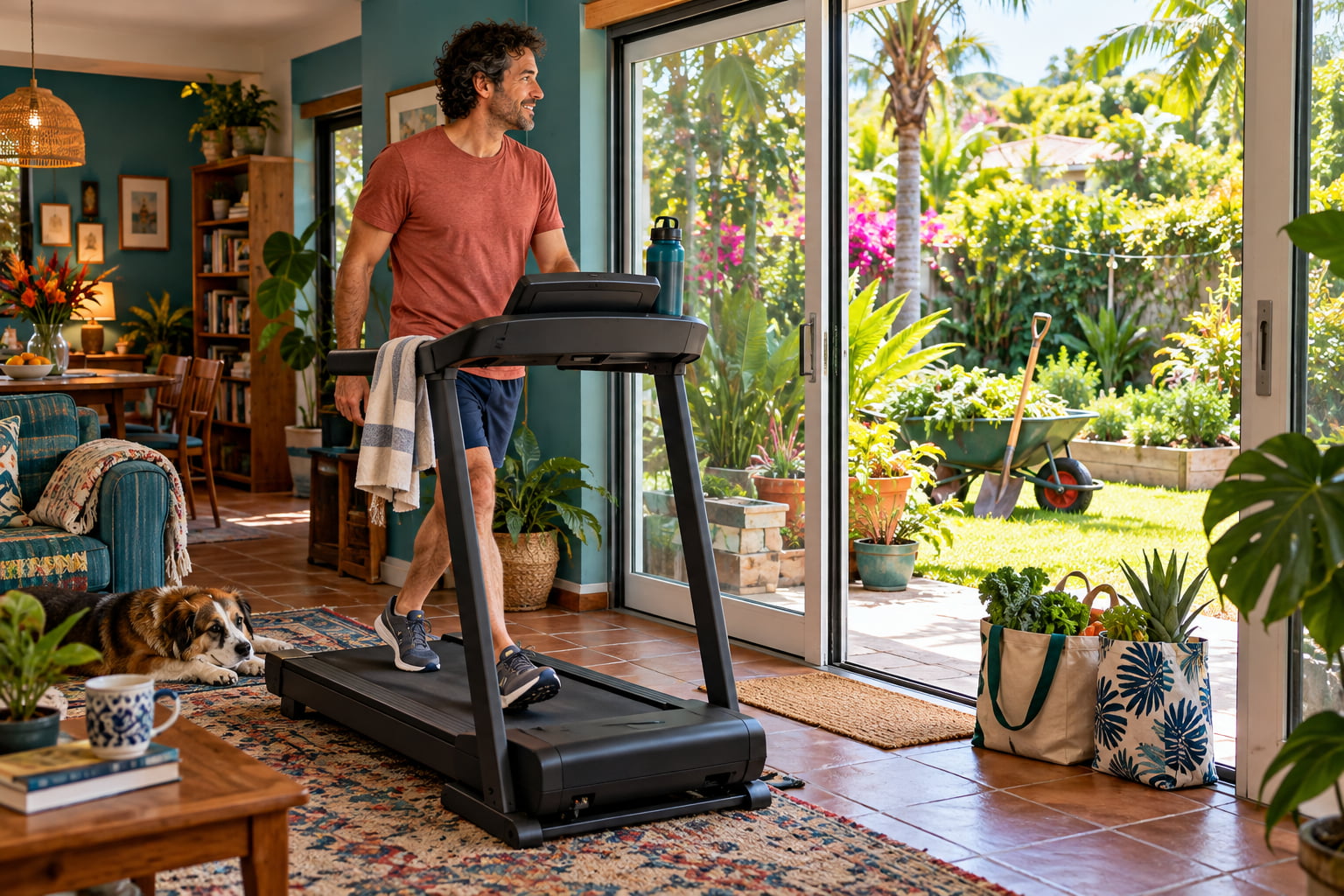
There is something ridiculous about driving somewhere so you can walk on a machine.
I say this as someone who owns a treadmill and is quite happy to have it. Florida regularly supplies weather in which a climate-controlled walk to nowhere feels less like surrender and more like evidence of sound judgment. Still, I find the arrangement curious: we have spent generations engineering physical effort out of ordinary life, then built an entire industry around putting some of it back.
Now we schedule movement.
We put it on the calendar, measure it with watches and drive to buildings full of machines designed to simulate activities our lives no longer require. A perfectly sensible response to the lives we have constructed, perhaps, but it leaves me with a question that reaches considerably farther than the gym:
When we remove difficulty from life, what else disappears with it?
I Was Waiting for FaceTime Before FaceTime Existed
I was nineteen when I moved to Florida, about 1,200 miles from the small town where I had grown up. Until then, I had essentially lived within a hundred feet of home. My younger brother was fourteen, my sister was still in school, and suddenly everybody I loved was somewhere else. I could not wander into the next room to see what somebody was doing or sit at the kitchen table and catch up. Home had become a voice on the telephone.
I remember thinking how wonderful it would be if someone could make a phone where we could actually see each other while we talked. Why couldn’t they do that? Apparently, given enough time, somebody agreed with me.
I have now lived long enough to watch that impossible little idea become ordinary in a world where people sometimes become mildly alarmed if you call without first sending a text explaining why. And I love being able to see someone hundreds or thousands of miles away. Grandparents can watch babies grow between visits; scattered families can see one another’s faces instead of imagining the expression on the other end of the line.
I am not going to pretend life was more authentic when long-distance calls cost a fortune. That would be nostalgia doing some heavy editing. Refrigeration is wonderful, washing machines were an excellent development, and modern anesthesia can stay. Anyone suggesting that air conditioning has weakened the moral fiber of Floridians is welcome to conduct that experiment in August.
But knowing what a convenience gave us does not necessarily tell us everything about the exchange. FaceTime added something I could not otherwise have across that distance. Other conveniences replace an activity outright, and that is where I started wondering whether we always know what we have replaced.
The Errand Was Never Just the Errand
Consider something as ordinary as running to the store. Acquiring groceries required a body to go somewhere: walk across a parking lot, wander through aisles, bend, reach, push a cart, load bags and carry them inside. Along the way you might run into someone you knew, exchange three sentences with a cashier who recognized you, or discover that half the town apparently also forgot milk.
None of this was remarkable, which is precisely why it is easy to overlook. Now I can tap a screen and groceries materialize outside my house. On certain days I consider this one of civilization’s finer achievements. But delivery removes more than the shopping. It removes much of the walking, standing, reaching and carrying that happened to be bundled inside it, along with whatever incidental human contact that particular errand might have supplied.
Researchers have been examining movement that occurs outside formal workouts, including brief bouts of what they call intermittent lifestyle physical activity. The distinction is useful because a person can report doing no structured exercise while still moving briskly, climbing stairs or doing demanding work in the course of an ordinary day.
In a 2023 study of adults who reported no leisure-time exercise, short bouts of moderate-to-vigorous activity recorded by wrist-worn devices were associated with lower risks of death and major cardiovascular events. A 2025 analysis also found associations between moderate or vigorous incidental activity and lower cardiovascular risk; the findings for light activity were weaker.
A 2026 study of US adults found a similar association between brief vigorous activity and lower mortality, but the relationship weakened and became less certain when participants with existing cardiovascular disease or cancer were excluded. That matters: people may move less because they are already ill, which can make movement look more protective than it actually is.
All of this is observational research. It cannot prove that a particular chore will prolong your life, and it gives us no reason to pretend dusting and hauling heavy bags are interchangeable. I am not interested in turning housework into the next longevity religion. What interests me is that movement outside a workout is worth examining at all. Our familiar division between “exercise” and “everything else I did today” can hide a considerable amount of activity.
Work That Happens to Exercise You
Gardening makes that distinction very easy for me to understand. I dig, haul, bend, carry, drag things that should have been moved before I planted around them and walk back for the same tool I somehow left forty feet away for the third time. My body is doing plenty, but my mind is not negotiating with exercise.
The movement has a reason. Something needs planting, cutting back or moving, and my body happens to be the equipment required to accomplish it. When I finish, I have moved and something in the world is different because I did. That combination makes the effort feel different to me; I get the physical participation and the satisfaction of having done something useful.
I do not need gardening to produce morally superior muscles for that to matter. Nor do I need every useful task to become a substitute for deliberate training. If I want to build a particular capacity, I may need to work on it specifically. But when I look only for the time I spent “exercising,” I miss the way movement already belongs to some of the things I enjoy doing.
This is where convenience becomes a more interesting question than whether I should hire someone to mow. What am I relieved to hand over, and what do I actually like participating in? Those answers may change with my health, responsibilities or season of life. There are days when having someone else handle the job gives me room to do something I value more. There are also jobs I would miss if efficiency quietly removed me from them.
What Is This Difficulty Doing Besides Irritating Me?
Cooking carries a similar bundle. Preparing a meal involves planning, chopping, tasting, remembering, improvising and gradually learning how to feed yourself and other people. A prepared meal can be exactly what someone needs. Still, if I stop cooking altogether, I may eventually discover that I miss more than the food I used to make.
The same question can follow us into other parts of life. If navigation software directs every turn, how much attention am I paying to the place? If AI handles a piece of thinking, which part have I happily delegated and which part do I still want to practice? These are questions about how we use the tools, not proof that everyone using them is losing a capacity. A tool can also make participation possible where it was previously difficult or out of reach.
“Frictionless” is nevertheless one of those words modern business treats almost religiously: fewer clicks, faster checkout, instant access, no waiting between wanting something and having it. Sometimes this is magnificent. If I am trying to refill a prescription, I do not need the website giving me an opportunity for personal growth.
But friction is a poor category for deciding what deserves to disappear. It lumps pointless bureaucracy together with the effort of learning to do something well. Cooking badly and then less badly may be irritating, but it is also part of becoming competent. Solving a problem can give me something that receiving the answer does not. Whether that effort is worth keeping depends on the task, the person and what else is being asked of them.
So I want to know what the difficulty is doing besides irritating me. Sometimes the answer is absolutely nothing useful, and I will be delighted to see it go. Sometimes it is carrying practice, attention, skill or contact with another person that I would rather keep.
There is a further complication: saving time does not decide what happens to that time. If a service gives me thirty minutes back, do I spend them resting, being with someone or doing something I wanted to do? Or do they become room for another task, another obligation or another scroll? I can be extremely efficient at clearing space and then immediately filling it. The machine did its job. I may still need to examine what I did with the result.
Where Did Movement Go?
When I bring this back to the body, the question shifts. Work, errands, meals, family and responsibilities already occupy the day, and now I am supposed to find a separate interval for movement after making so much of the rest of life physically easier. No wonder that arrangement sometimes feels ridiculous.
Where did movement disappear from my life, and do I want some of it back?
I can ask that without inventing chores or carrying sacks of flour for character development. Perhaps I want to garden because I like what happens to both my day and my yard when I do it. Perhaps there is something I have been handing over that I am capable of doing and would enjoy doing again. Perhaps the convenience is protecting energy I need elsewhere, and I want to keep it exactly as it is.
I also do not have to resurrect the entire burden to recover something valuable. Grocery delivery can stay while I find another reason to walk or see people. I can use the machine for a job I dislike and keep a different task that gives me a satisfying reason to move. The useful part of the old arrangement may be recoverable in a form that fits my life now.
If this brings your own relationship with movement to mind, I followed that thread more personally in Case File 008: I Finally Learned to Exercise by Stopping “Exercising”.
The Ledger Needs Both Columns
FaceTime still feels a little miraculous when I remember nineteen-year-old me wishing for it. It gave me more contact across a distance; it did not make sitting beside someone obsolete. I can appreciate the technology completely and still want the visit.
That is the kind of attention I want to bring to the rest of these choices. Progress deserves both columns in the ledger: what it gave me and what it removed. The second column may be full of things I am thrilled never to do again. It may also contain movement, skill, patience, competence, human contact, attention, memory, effort or purpose that I had stopped noticing because it arrived inside an ordinary task.
Did this convenience remove anything I would rather put back on purpose?
One familiar convenience is enough to begin with. I can look at the exchange, consider whether I miss anything and decide whether there is a sensible way to recover it. I might change something, or discover that the arrangement is serving me beautifully. Either way, I will know more about what I am choosing.
My treadmill can stay. So can FaceTime and the air conditioning. I would just like to be consulted before we automate all the things I enjoy doing.
ONE MORE THING WORTH NOTICING
Want to keep pulling on threads like this one?
Moxie Moments is my occasional note about what I’m noticing, questioning, and still chewing on—in health and in life.
Quick Takeaways
- Convenience can remove a bundle of experiences along with the obvious burden: movement, practice, attention, skill or human contact.
- Movement outside formal workouts deserves attention, but the research does not make every chore equivalent or prove that a particular task prolongs life.
- You can keep a convenience and recover something valuable in another form; bringing back the entire burden is not required.
- Start with one familiar convenience and ask: Did this remove anything I would rather put back on purpose?
Referenced Studies & Sources
| Title | Link |
|---|---|
| Brief Bouts of Device-Measured Intermittent Lifestyle Physical Activity and Its Association with Major Adverse Cardiovascular Events and Mortality in People Who Do Not Exercise: A Prospective Cohort Study | https://pubmed.ncbi.nlm.nih.gov/37777289/ |
| Dose Response of Incidental Physical Activity Against Cardiovascular Events and Mortality | https://pubmed.ncbi.nlm.nih.gov/40228066/ |
| Vigorous Intermittent Lifestyle Physical Activity (VILPA) and Mortality Risk Among US Adults: A Wearables-Based National Cohort Study | https://link.springer.com/article/10.1186/s12966-026-01876-2/spac |