
I bought some overnight oats because the marketing got me. Thirty grams of protein, plant-based, convenient, all packaged up in a tidy little promise that breakfast could be handled before I even went to bed.
Fine. Sold.
I mixed them up that night and took a taste before putting them in the refrigerator. That was when I noticed the pea protein.
Pea protein and I have a love-hate relationship, except there is not actually much love involved. I can taste it immediately. There is something medicinal about it to me, along with this powdery mouthfeel and an aftertaste that seems determined to stay until lunch. I remember tasting those oats and thinking, Oh no.
And then I put them in the refrigerator anyway.
I honestly do not know what I thought was going to happen overnight. Perhaps the oats and the pea protein were going to have a little party in there, work out their differences, and emerge eight hours later with a lovely new personality.
They did not.
The next morning they were cold, thick, medicinal, and every bit as unpleasant as I remembered. I tried several bites anyway because I have a long history of being willing to eat something I do not especially like once I have decided it is good for me. Enough protein? Fine. More fiber? Fine. Some ingredient I have been told I absolutely need? Hand me the spoon.
But I could not do these.
I finally looked at that container and had the rather obvious thought that I did not have to eat it.
I am sixty years old. I bought the breakfast. Nobody was standing in my kitchen requiring me to finish it. There was no medal coming, and the thirty grams of protein were not going to climb out of the bowl and congratulate me on my discipline.
I could throw the damn thing away.
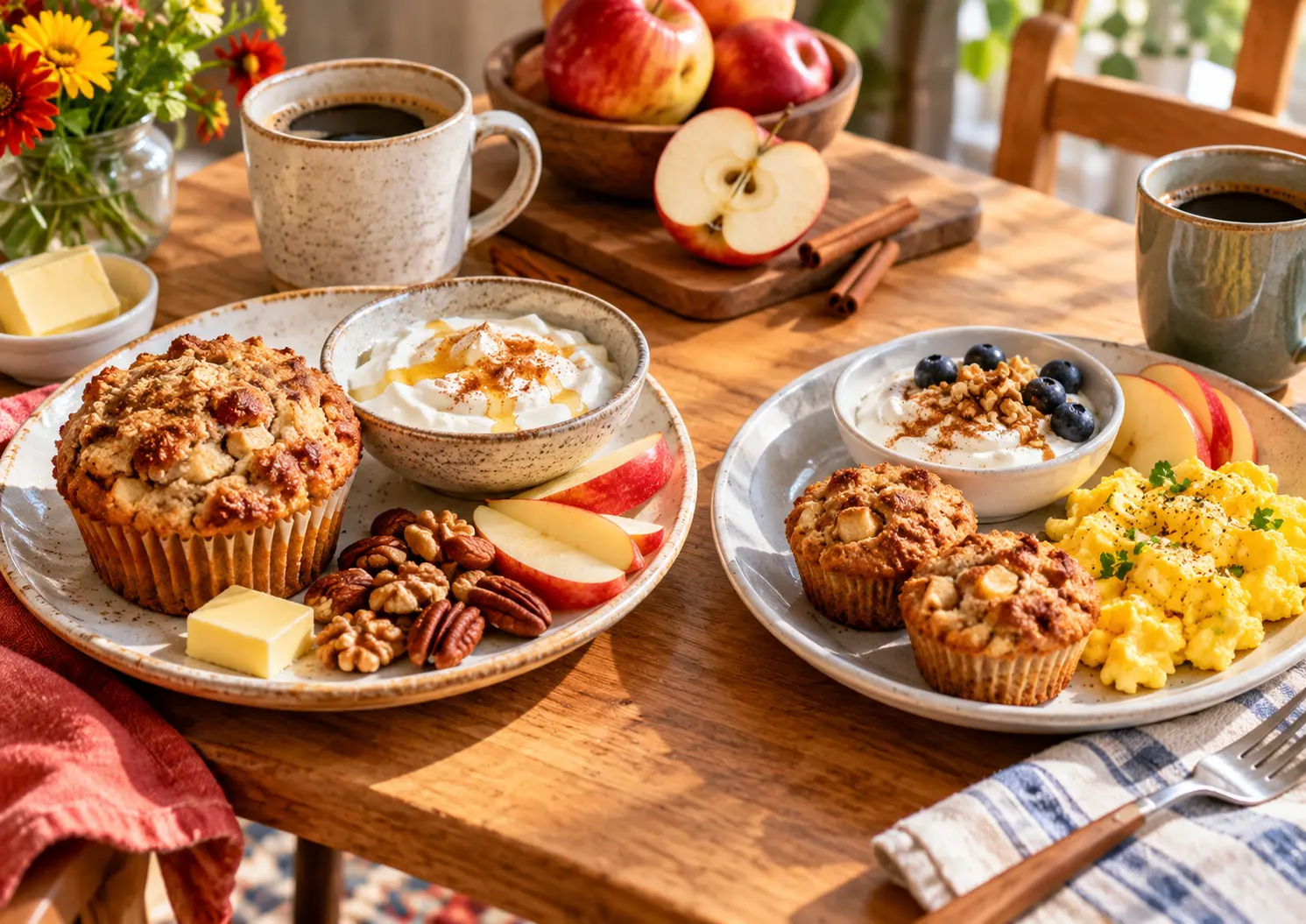
Oddly enough, that little moment followed me around, because at almost the same time I had been looking at an apple cinnamon muffin recipe and thinking about how I could change it. Less added sweetness. Sourdough. Nuts. Greek yogurt. Something Jerry would enjoy and something I could freeze in those little two-bite portions I like.
At first those two foods seemed to occupy opposite ends of the healthy-eating universe. One came dressed for the part with thirty grams of protein printed on the package. The other was a muffin.
Except the muffin made more sense in my actual life.
And that is where this got interesting.
The Same Muffin Is Not the Same Food
Jerry needs calories.
I do not have that particular problem.
This has been true in one form or another for most of our marriage. We are two different people living in the same house with two different bodies, appetites, health histories, ages, activity levels, and nutritional needs. That fact is so obvious that it hardly seems worth saying until you notice how often nutrition advice pretends it is not true.
If I make a batch of those apple muffins, Jerry may eat one as part of breakfast, another later in the day, put butter on one if he wants it, and generally use them as another pleasant way to get food into him.
I can eat the exact same muffins. I just do not need them to do the same job.
For me, making them small means I can have one or two with eggs or Greek yogurt, enjoy the cinnamon and apples and crunchy nuts, and go on with my day. I do not need to turn the recipe into some joyless approximation of a muffin just because my body does not need extra calories. Nor do I need to eat four of them because they contain sourdough and apples and nuts and therefore we have apparently declared them “healthy.”
That is where the usual good-food/bad-food conversation starts falling apart.
What exactly are we asking when we ask whether a food is healthy?
Healthy for whom?
For what?
Under what circumstances?
We toss that word around as though foods carry permanent assignments. Oatmeal is healthy. Muffins are not. Protein is good. Sugar is bad. Nuts are healthy, until apparently you eat too many of them and then somebody would like to discuss calories. Eggs have spent decades moving in and out of nutritional respectability depending on what year you happen to be standing in.
It is no wonder people are confused.
We keep trying to make food answer a yes-or-no question when the more useful answer is very often, It depends.
That does not mean nutritional science is useless or that anything goes. It means a general principle still has to survive contact with an individual human being.
Bodies are not interchangeable. Energy needs differ. Muscle mass differs. Appetite differs. Activity differs. Age matters. Health conditions matter. Medications can matter. Men and women are not physiologically identical, but neither are all women identical to one another or all men to one another. Once you start adding the actual person back into the equation, the tidy rules get considerably less tidy.
Which is inconvenient if what we really wanted was a list.
It is much more useful if what we wanted was understanding.
The thirty grams of protein on my overnight oats were not fake. That number really did tell me something about the food. What it did not tell me was whether I needed thirty grams of protein from that particular food, whether I would enjoy eating it, whether it would satisfy me, or whether there were ten other ways I could accomplish the same nutritional goal without feeling as though I were taking medicine.
The label gave me data.
I was the one who had to decide what the data meant in my life.
That is a very different relationship with food.
And Then There Is the Person Feeding Everybody
There is another reason this subject caught me, and I suspect this one will be familiar to people who naturally take care of others.
When you are the person primarily responsible for food in a household, you become a walking database of everybody else’s needs.
You know what they like and what they will leave sitting on the plate. You remember that somebody is tired of chicken, somebody needs more protein, somebody needs more calories, somebody’s stomach has been touchy, there is half a container of something in the refrigerator that needs to be used, the bananas are three hours away from becoming banana bread, and whatever you cook tonight really should produce enough leftovers to make tomorrow easier.
It is part nourishment, part logistics, part budgeting, part love, and some evenings part hostage negotiation.
I do this naturally. I nurture people with food. I like knowing what somebody enjoys and making it for them. If someone I love needs more nourishment, my brain immediately begins figuring out how to get it into them in ways they will actually want to eat.
There is nothing wrong with that.
But there is a trap hiding in it.
You can become so practiced at asking what everybody else needs that you stop asking what you need.
Not in the scented-candle version of self-care. I mean the ordinary, practical question.
Does the way I am feeding this household also make sense for my body?
That is not always the same question.
Jerry needing more calories does not mean I should eat as though I need more calories. My wanting to be thoughtful about my portions does not mean Jerry should have to eat according to my goals. We also do not need separate refrigerators, separate dinners, and a color-coded food-prep system that turns supper into a military operation.
Mostly we need to notice.
Maybe he gets the larger portion. Maybe I add more vegetables to mine. Maybe his oatmeal gets nuts, maple syrup, and whatever else sounds good while mine is built differently. Maybe we eat exactly the same dinner but not in exactly the same proportions. Maybe he has the muffin with butter and I have two little ones beside eggs.
Nobody has failed.
The meal simply has to serve more than one person.
Once I saw it that way, I realized this goes far beyond my kitchen. And the curiosity ramped up.
How many people are eating according to the needs of the person beside them without ever quite deciding to?
How many couples gained weight together because portions slowly became identical even though their bodies were not?
How many caregivers grab whatever is easiest after spending the day making sure someone else eats properly?
How many parents finish what the kids leave behind because throwing food away feels wasteful?
How many people are dutifully drinking a protein shake they hate because somewhere along the way they stopped asking whether there might be a better way to meet the same need?
These are not dramatic nutritional failures.
They are patterns.
And patterns are worth noticing.
I Am Also Done Pretending Food Does Not Have to Taste Good
Those overnight oats brought up something else I think I am increasingly unwilling to tolerate.
Why are we so comfortable with the idea that healthy food can be awful?
We accept the strangest bargains. If something has enough protein, fiber, probiotics, greens, adaptogens, collagen, or whatever nutrient is currently being marketed with great enthusiasm, apparently we are expected to forgive texture, flavor, aftertaste, and sometimes our own basic will to live.
I am exaggerating.
A little.
Obviously there are circumstances where medical needs limit choices, and not every meal needs to be some memorable culinary event. Sometimes you eat the yogurt because it is there and you need breakfast.
But I no longer believe enjoyment is irrelevant.
Food has to function in real life.
If Jerry needs more calories, handing him a technically perfect food he does not want is not particularly useful. If I want more protein in my breakfast, forcing myself to eat pea-protein oatmeal that makes me dread breakfast is not some higher form of nutritional discipline. I can eat eggs. I can eat Greek yogurt. I can use foods I like.
There is a strange moral layer that has attached itself to eating, particularly around foods marketed as healthy. We start treating the ability to tolerate unpleasant food as evidence of commitment. Perhaps that works for some people.
I have reached the stage of life where my response is increasingly: why?
Why am I eating food I hate when I have perfectly reasonable alternatives?
Why am I making every pleasurable food defend itself before I am allowed to enjoy it?
Why does a muffin require an attorney while a highly processed bowl of expensive powder gets waved through security because it contains thirty grams of protein?
Come on. The protein matters.
So does everything else.
ONE MORE THING WORTH NOTICING
Want to keep pulling on threads like this one?
Moxie Moments is my occasional note about what I’m noticing, questioning, and still chewing on—in health and in life.
Food Has a Job
That is the thought I finally landed on.
Instead of asking whether a food is healthy, I want to know what job I am asking it to do.
Sometimes the job is protein.
Sometimes it is additional calories.
Sometimes it is making a meal satisfying enough that I do not spend the next three hours prowling the kitchen.
Sometimes it is getting some food into a person who has very little appetite.
Sometimes it is convenience.
Sometimes it is fiber or hydration or easy carbohydrates before activity.
Sometimes it is Sunday dinner with people I love.
And, yes, sometimes the job is simply to taste wonderful.
One food may do several of those things at once. That is where the apple muffin makes a much better teacher than the pea-protein oatmeal.
The muffin does not have to become a health food to belong in my life. I simply have to know what I am doing with it.
For Jerry, those muffins can be an easy source of additional calories in a form he enjoys. For me, they can be a deliberate pleasure that fits quite comfortably into the way I want to eat.
Same muffin.
Not the same job.
And because I do not want this Case File to end with another lovely idea that evaporates the next time somebody is standing in front of the refrigerator, I think there is a practical way to carry the question with us.
THE FOOD JOB CHECK
Before automatically deciding that a food is “healthy” or “unhealthy,” give it a little context.
Who is eating it?
Not some theoretical healthy person. This person. Their age, body, appetite, activity, health, preferences, medications, circumstances, and goals.
What does this person need from food right now?
More energy? Less energy? Protein? Satiety? Something easy to digest? Help maintaining weight? Help gaining it? Something quick? Something they will actually eat?
What job is this particular food doing?
Is it the meal? Part of the meal? A snack? Fuel? Recovery? Convenience? Pleasure? A way to increase calories? Something chosen because it keeps you satisfied longer?
What else is happening around it?
Portion matters. Pairing matters. The rest of the meal matters. The rest of the day matters. One muffin with eggs is not the same eating pattern as absentmindedly working through half the batch while standing at the kitchen counter.
Do I actually like it?
This one stays on my list now. If I repeatedly dislike a food, I want a better reason than impressive packaging before I keep buying it.
The question becomes less about assigning a moral grade to the food and more about understanding the situation:
Does this food make sense for this person, in this context, for the job it needs to do?
I can do something with that question.
It allows nutritional principles to remain useful without requiring me to pretend that everybody should eat alike. It makes room for different bodies at the same table. It also makes room for pleasure without turning pleasure into permission to stop paying attention.
That feels much closer to intentional eating than either extreme.
I do not want to spend my life dividing foods into virtuous and forbidden categories. I also do not want to shrug and pretend that what I eat has no consequences because “everything in moderation” sounds pleasantly uncomplicated.
I want to notice what I am doing. That is different. So, I am going to make the apple muffins.
Jerry can eat them in the way that supports what his body needs right now. I can eat them in the way that supports mine. We can sit at the same table and enjoy the same batch without requiring the food—or ourselves—to be exactly the same.
And those overnight oats?
They went in the trash.
Thirty grams of protein and all.
Quick Takeaways
- “Healthy” is often an incomplete question because the same food can serve very different purposes for different people.
- General nutrition principles still matter, but they have to meet an actual person: their body, appetite, activity, health, preferences, medications, circumstances, and goals.
- When you regularly feed other people, it is remarkably easy to become fluent in everybody else’s nutritional needs while forgetting to ask what your own body needs.
- Enjoyment belongs in the calculation. A food with an impressive nutrition panel is not especially useful if you hate eating it and have reasonable alternatives.
- Instead of assigning food a permanent good-or-bad label, ask what job it needs to do for this person, in this context.
FAQs
Is the same food healthy for everyone?
Not necessarily. Basic nutrition principles still apply, but whether a particular food makes sense can depend on the person’s energy needs, appetite, activity, health circumstances, goals, preferences, and what else they are eating. The more useful question is often not whether the food is universally healthy, but whether it fits the person and the situation.
Can two people in the same household need different portions or meals?
Absolutely. Two people can share most of the same foods while needing different portions, additions, pairings, or meal patterns. One person may need more calories, for example, while another may be trying to eat more intentionally without preparing an entirely separate dinner.
Does healthy eating have to mean giving up foods like muffins?
No. A muffin does not become nutritionally meaningless because it is enjoyable, nor does including one automatically make an eating pattern unhealthy. Portion, frequency, what accompanies it, nutritional needs, and the larger pattern all matter.
What is the Food Job Check?
The Food Job Check is a simple MoxieMart tool for putting food into context. Ask who is eating it, what their body needs, what job the food is doing, what else is being eaten with it, and whether the person actually enjoys it. The goal is to make a thoughtful decision rather than automatically labeling the food good or bad.
What if a “healthy” food has great nutrition numbers but I hate eating it?
The nutrition information is still useful, but it does not obligate you to eat that particular food. If other reasonable foods can meet the same nutritional need and you actually enjoy eating them, those may work better in your real life. Food has to function outside the nutrition label too.