
There was absolutely no reason for me to make that third graphic.
I knew this.
The Local Spotlight posts I create for PFG already had what they needed. The business was featured, the information was there, and the package worked.
But I had another testimonial. Testimonials are useful. I could see exactly where it would fit and how to make the whole thing feel a little more complete.
You see where this is going.
So I made another graphic.
It looked nice. It did make the package more complete. It also took a ridiculous amount of time for something that, if we are being truthful, probably changed almost nothing about the outcome.
Nobody had demanded it. Nobody was waiting anxiously for Graphic Number Three. There was no small-business owner pacing the floor somewhere in Brevard County wondering whether I would please, for the love of Pete, complete the testimonial trilogy.
I did it because I could see how to make it better.
There is a trap hiding inside that sentence, and I have begun noticing how often I fall into it.
Once you can see the better version of something—and know perfectly well that you are capable of producing it—the version already sitting in front of you can begin to feel inadequate. Not because it actually is inadequate. Because now you know what else is possible.
Apparently, in my own mind, possibility has been carrying far too much authority.
When Capability Quietly Becomes the Standard
I have always been inclined to build things.
Not necessarily physical things, although the kitchen has recently provided more field research in that department than anyone requested. I mean systems, ideas, processes, packages, frameworks and plans.
Give me a loose thread and there is a reasonable chance I can turn it into a sweater before lunch. That inclination has served me well for most of my life. It has also gotten me into trouble.
MoxieMart itself is a fine example.
There was an earlier version of Moxie with six pillars, elaborate entry points, complete sequences and enough interconnected architecture to suggest that perhaps I had mistaken a website for the interstate highway system.
It wasn’t stupid.
I want to be clear about that because I think we are sometimes too quick to look at an abandoned system and declare the whole thing a mistake. It was thoughtful. Much of it made sense. Parts of it were quite good. I could explain why every piece existed, what it connected to and how the reader could theoretically move through the beautiful machine.
There was only one small problem.
I had to operate the machine.
Eventually that forced a question I had not asked while I was happily designing the thing:
Was all that complexity creating enough additional value to justify what it required from me?
That is an entirely different question from whether I was capable of building it.
Capability asks, Can I do this?
Wisdom has the nerve to ask, Is this worth doing?
I have apparently spent several decades allowing the first question to answer the second.
“Good Enough” Has a Branding Problem
“Good enough” is not an especially inspiring phrase.
Say it aloud and it sounds vaguely defeated. Fine. That’ll do. You can practically hear someone shrugging while a screen door bangs behind them.
For people who care deeply about doing things well, it can feel almost morally suspect.
We are not advocating sloppiness here. Nobody wants the surgeon, electrician, pilot or person tightening the bolts on the roller coaster cheerfully embracing a philosophy of close enough.
Standards matter. Details matter. Excellence can matter enormously. But that is precisely why I think we need to become much more discriminating about it.
Because excellence does not matter equally everywhere.
Research on perfectionism is more nuanced than the popular shorthand that perfectionism is simply bad and we should all learn to lower our standards. Researchers commonly distinguish between high personal standards or perfectionistic striving and the more troublesome side of perfectionism: excessive concern over mistakes, chronic doubts about performance and harsh self-evaluation when reality does not match the ideal.
That distinction makes sense to me.
Wanting to do excellent work is not necessarily the problem. The problem comes when excellence becomes the default price of admission for everything.
Everything cannot matter equally. The email does not deserve what the marriage deserves. The drawer organizer does not deserve what the medical decision deserves. The third testimonial graphic does not deserve what the Case File deserves.
Yet capable people may be especially vulnerable to blurring those distinctions because the extra effort often remains within reach. We do not encounter a clear boundary that says, Stop here. The meaningful work is finished. Instead, we see another possibility. We could make it cleaner, add another layer, research another option, tighten one more thing or create a more complete system.
And because we could, the decision not to do it begins to require justification.
I think I have had that backward.
Seeing an improvement tells me that an improvement is possible. It does not tell me that the improvement is necessary. More importantly, it does not make me responsible for producing it.
I Have Built a Few Cathedrals Where a Shed Would Have Done Nicely
Once I started looking at my life through that lens, the pattern was difficult to miss.
There are things I have made more complicated because complexity genuinely served the outcome. And there are things I have made more complicated because complexity was available to me.
That old Moxie system taught me a great deal. Parts of what exists now came directly from learning what worked there and, perhaps more importantly, what required far too much tending for what it gave back.
That matters because we tend to calculate the cost of creating something without giving equal consideration to the cost of continuing to own it.
A complicated system does not stop costing you when the building is finished. It has to be maintained, remembered, updated, connected, explained and repaired when one part changes and knocks something else sideways.
It occupies mental real estate.
And that is true far beyond websites. We can build this kind of infrastructure around routines, commitments, possessions, projects, expectations and elaborate ways of doing ordinary things.
Every additional piece may become another thing that someday wants something from us.
A system can therefore be impressive and still be too expensive. That has become an important distinction for me. I do not need to prove that the elaborate version was foolish before I am allowed to choose the simpler one. Something can be smart, useful, well-designed and still demand more than its value warrants.
Maybe that is where “good enough” begins to shed its sad little reputation.
Not as resignation. As discernment.
Simplicity, I am discovering, is not necessarily the absence of ambition. Sometimes it is ambition finally learning to count the bill.
Then the Kitchen Started Teaching the Same Lesson
Our kitchen organization project took an entire day.
There were drawers emptied, things measured, organizers shifted around, categories reconsidered and enough miscellaneous kitchen equipment on the counters at one point to suggest we had been raided by a very tidy burglar.
When it was finished, I was genuinely pleased.
Not because we had achieved some transcendent level of drawer organization.
The drawers worked. I could find things. The things fit. The kitchen made more sense.
It was finished, functional and better.
That was enough.
Then there was the pantry cabinet.
At some point during assembly, I managed to install the bottom-right doors upside down. I would like the record to show that the instructions were not exactly a triumph of modern communication, but nevertheless: upside down.
There was a time when knowing that would have bothered me enormously. I would know those doors were wrong. They could sit there functioning perfectly well for fifteen years while some ridiculous corner of my brain whispered every time I walked past, You know what you did.
Except Jerry MacGyvered them.
They work. You cannot tell. The cabinet is standing and civilization has, to date, continued.
And I realized something rather lovely about that.
We did not declare the mistake perfect. We did not lower the standard until anything counted. We looked at what it would take to correct the mistake, looked at what correcting it would actually change, and decided the repair would cost more than the correction was worth.
That is not laziness.
That is judgment.
Excellence Should Have to Earn Its Cost
This is where “good enough” becomes useful to me, because I do not want it as a blanket philosophy.
There are places in my life where I want extraordinary care.
If I am investigating a health claim for MoxieMart, truth matters more than speed. Sources matter. Context matters. I am quite happy to be persnickety because getting it right affects what I am giving another human being.
If I am helping make a medical decision for someone I love, “eh, close enough” will not be our operating principle.
And if I am writing something that matters to me, I may stay with a sentence because sometimes the exact language does change what reaches the reader.
There are places where excellence earns its cost. Perhaps that is the standard I have been looking for. Excellence should have to earn its cost. Not because excellence is undesirable, but because excellence is never free.
It takes time, attention, energy, thought, maintenance and sometimes money. Every one of those resources spent here is unavailable somewhere else.
That changes the questions.
What is this thing actually supposed to do? Who is it supposed to serve? What would become meaningfully better if I spent another hour on it? And what else does not receive that hour if I do?
That last question may be the one I have underestimated most.
The cost of unnecessary improvement is not only the time added to the project. It is whatever that time no longer gets to become: another piece of work that mattered more, a conversation, a walk, a book, an idea, sleep, quiet, or simply a little portion of life in which nothing else was waiting to be optimized.
At some point I have to admit that nobody is handing out extra credit for all of this. And if they are, I am no longer convinced I want what they are giving away.
Finished Has Value Too
I also think I have underestimated the value of completion.
There is a particular relief in something no longer asking anything from you.
A drawer that closes and works is no longer a project. A cabinet that functions is no longer an open problem. A post that has been scheduled is finished. A system simple enough to maintain stops humming in the background of your brain quite so loudly.
That matters in a life already full of open loops.
The trouble with imagination is that there will always be another possible improvement. I can almost always see something else I could do.
And sometimes I should do it.
But better is not free, and better is not the same thing as meaningfully better.
That distinction may be the whole Case File.
The Question I Am Learning to Ask
I said recently that “Simplify” may be my word for 2027.
I said it almost casually, but I am beginning to suspect simplification is already underway.
Not the aesthetic version in which I own three beige shirts and a single tasteful wooden spoon.
Something deeper.
Simple. Truthful. Helpful.
Those words have been emerging as a standard for MoxieMart, and I am beginning to understand why they feel so right.
They force me back to purpose.
Does this help? Is it true? Does this additional machinery make the thing more useful, or have I simply demonstrated once again that I know how to build machinery?
That question travels surprisingly well.
I can use it on a project, a routine, a purchase, a room, a commitment, a plan or an expectation I have carried so long that I forgot I was allowed to reconsider it.
This is not an argument for caring less.
I think it may be an argument for caring more deliberately.
Spend excellence where excellence changes the outcome. Let “good enough” handle the things where it does not. Because capable people may always be able to imagine the better version. We may even know exactly how to build it.
But our capacity is not an instruction.
Just because I can make something better does not mean making it better is worth the cost.
I wish I had understood that earlier. Then again, perhaps this is one of those lessons you cannot simply be told. Maybe you have to build a few unnecessary cathedrals, organize a few drawers, install at least one cabinet door upside down and finally notice how very pleasant it is when something simply works.
So this is the question I am carrying forward:
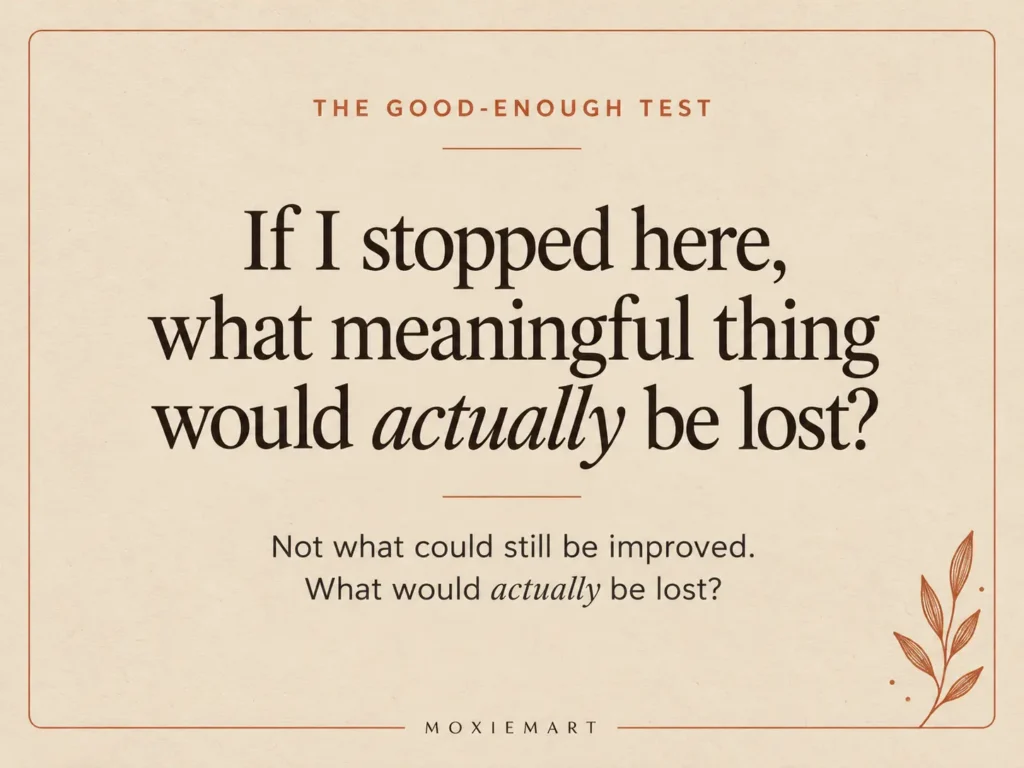
If I stopped here, what meaningful thing would actually be lost?
Not what could still be improved. There will almost always be an answer to that. What would actually be lost?
If I can name something that matters, perhaps the extra work deserves the time.
If I cannot, perhaps the work is already complete.
Quick Takeaways
- High standards and compulsively improving everything are not the same thing.
- Seeing a better version creates a possibility, not an obligation to build it.
- Excellence has a real cost in time, attention, maintenance and opportunity; that cost is worth paying where excellence meaningfully changes the outcome.
- “Good enough” is not permission to stop caring. It is permission to decide what deserves extraordinary care.
- A useful stopping question is: If I stopped here, what meaningful thing would actually be lost?
ONE MORE THING WORTH NOTICING
Want to keep pulling on threads like this one?
Moxie Moments is my occasional note about what I’m noticing, questioning, and still chewing on—in health and in life.
Referenced Studies & Sources
| Title | Link |
| Multidimensional Perfectionism and Burnout: A Meta-Analysis | https://pubmed.ncbi.nlm.nih.gov/26231736/ |
| Perfectionism and the Five-Factor Model of Personality: A Meta-Analytic Review | https://pubmed.ncbi.nlm.nih.gov/30612510/ |
| Personal Standards and Evaluative Concerns Dimensions of “Clinical” Perfectionism: A Reply to Shafran et al. (2002, 2003) and Hewitt et al. (2003) | https://pubmed.ncbi.nlm.nih.gov/16301015/ |
FAQ
Is “good enough” the same as lowering your standards?
No. The useful distinction is whether additional effort meaningfully changes the outcome. Some work deserves exceptional care. Other tasks simply need to perform their intended function reliably and well.
How do I know when something is good enough?
Ask what the work is supposed to accomplish and what would meaningfully be lost if you stopped now. If the remaining improvements are mostly marginal rather than consequential, you may already be finished.
Can perfectionism ever be useful?
Research suggests the answer depends partly on what we mean by perfectionism. High personal standards and perfectionistic striving are not identical to perfectionistic concerns such as excessive worry about mistakes, doubts and harsh self-evaluation. The latter are more consistently associated with negative outcomes.
Why is it hard for capable people to settle for good enough?
Capability can keep the next improvement within reach. Once we can see a better version and know how to produce it, stopping may feel like neglect—even when the additional effort changes very little. The better question is whether the improvement earns its cost.