I love me some Dr. Mercola, but that man will have me running six ways to Sunday trying to lose one pound.
This morning it was caffeine.
The article was about a new study looking at caffeine, exercise and fat burning, which is exactly the sort of thing I am going to click because I am interested in this stuff. I have been interested in it for most of my life, partly because I genuinely enjoy understanding how the body works and partly because weight has never been something I could simply forget about and assume would take care of itself.
I am 60 years old, and I swear I have been thinking about what I am supposed to eat so my ass does not get broad since approximately day zero.
That particular expression belongs to my father.
Years ago, I was getting my hair cut when he came by to see me, walked into the salon, looked me over and announced, “Well, your ass is getting pretty broad, Joni.”
There was no preamble. Apparently Dad had completed his assessment and saw no reason to delay publication.
The really irritating part was that he was not wrong.
So I have paid attention. I have lost weight, gained weight, learned about food, changed how I eat, exercised, stopped exercising, started again, watched my body behave differently at different ages and tried to understand why something that seemed straightforward on paper could become considerably less straightforward once an actual human body got involved.
I am still paying attention.
What I am getting tired of is how much paying attention now seems to require remembering.
We should eat a variety of foods because different foods bring different nutrients to the table, but we also need to watch how much we eat. Protein matters, particularly as we age, but so do fiber and micronutrients and food quality. Muscle matters. Movement matters. Sleep matters. Stress matters. Hormonal changes can matter. Medications can matter. How much we eat over time certainly matters, even though the amount a particular person needs is not stamped conveniently on her forehead.
Then there is meal timing, fasting, glucose response, exercise intensity, recovery, hydration, supplements and whatever else wandered into the health conversation while we were trying to make dinner.
Most of those things are not made up, which is precisely what makes this so exhausting.
If the whole wellness world were nonsense, we could toss it out and go make a sandwich. Instead, quite a lot of what comes across our screens contains some legitimate piece of physiology, some real study, some potentially useful observation or some idea that may indeed matter under the right circumstances.
Which means the problem is no longer simply figuring out what is true. We also have to figure out what deserves a place in our lives.
And this morning, caffeine wanted a place.
The Study Wasn’t Nonsense
The study that caught my attention involved eleven sedentary young women with overweight or obesity. Their average age was just over 20. Each woman completed several exercise sessions after taking either a placebo or one of three doses of caffeine, then walked on a treadmill at the intensity where her own fat oxidation had previously been measured as highest.
At the lower and middle caffeine doses, the women oxidized more fat during exercise than they did after the placebo. The highest dose did not produce additional metabolic benefit and caused greater cardiovascular effects.
There is other research behind the general idea too. Systematic reviews and meta-analyses have found that caffeine can increase fat oxidation during submaximal aerobic exercise under at least some conditions, although the size of the effect varies and appears to depend on things such as training status, habitual caffeine use, whether someone has eaten and the way the experiment is conducted. One broader review examining dozens of studies found an overall effect on fat metabolism, but characterized it as small.
So there is something here, and that matters because I do not want to dismiss a finding simply because acting on it would be inconvenient. That would be no more intellectually honest than swallowing every recommendation whole because someone attached a study to it.
But once I got past the interesting part, another question started bothering me.
What, exactly, am I supposed to do with this information?
The study did not show that these women lost more weight. It did not show that they lost more body fat over several months. It did not establish that strategically timing caffeine before exercise produces meaningful long-term weight loss.
It measured something narrower: what happened to fat oxidation during a particular bout of exercise after caffeine was consumed.
That is useful information, but it is not the same information as “caffeine helps you lose weight,” even though those two ideas can become neighbors remarkably quickly once a study leaves a journal and starts traveling around the internet.
The body can change which fuels it uses during a period of exercise without that automatically telling us what will happen to body weight or body fat over the next six months. Long-term weight change has to account for what happens across entire days and weeks, including energy intake, appetite, activity, adaptation and a host of individual circumstances that a 40-minute treadmill session cannot answer.
Once I understood what the study had actually shown, I no longer had a caffeine question.
I had a judgment question.
How Much Authority Does This Deserve?
That may be the piece I have been missing in a lot of health conversations.
We spend enormous amounts of time asking whether something is good or bad, true or false, beneficial or harmful. Those are reasonable questions, but they can still leave us stranded because something can be true without being terribly important, and something can be beneficial without being important enough to reorganize our lives around.
That distinction matters when the available supply of health advice appears to be infinite and our attention most certainly is not.
If I took every credible finding as an instruction, I could spend the rest of my life adjusting things. Maybe I should time my coffee before exercise or arrange carbohydrates around activity differently. Maybe I should alter when I eat protein, monitor glucose after particular meals or walk at a specific intensity because one intensity is supposedly better for one thing while another is better for something else. Maybe the latest supplement deserves a trial, and naturally we will also need to discuss the precise time of day I should take it.
None of those questions is automatically foolish. Together, however, they can create a life in which taking care of your body becomes an endless sequence of small compliance tasks.
That is where I think we have to get much better at judging scale.
A finding may be scientifically interesting without being practically important. A measurable change may be real without being large enough to matter to the outcome I care about. Something that matters greatly to an endurance athlete may be irrelevant to someone trying to preserve mobility. Something useful to a 20-year-old woman may deserve considerably less weight when I am trying to make decisions about my own 60-year-old body.
The question becomes less “Does caffeine increase fat oxidation?” and more “How much should that fact matter here?”
Now I have something I can actually use.
The participants in this study were much younger than I am. There were eleven of them. The study examined an acute metabolic response, not long-term weight loss. The broader literature suggests there is a real effect under at least some conditions, but nothing here looks like an enormous metabolic lever we have all somehow failed to pull.
Meanwhile, I already drink coffee. I already move. I have much larger things affecting my health and weight than whether my coffee happened to arrive at precisely the right interval before I exercised.
So this finding can be true without earning jurisdiction over my morning.
I like that distinction very much.
This Isn’t Permission to Stop Caring
There is another side to this that I cannot ignore, because I understand why people become exhausted enough to give up.
My mother eventually did.
Her weight became progressively more severe, and by the end of her life her mobility and independence had been profoundly affected. Moving her required a Hoyer lift.
I saw what happened. I cannot turn my mother’s life into a tidy moral about body weight, because lives and bodies are far more complicated than that. But I also cannot unsee the physical consequences that came with losing so much mobility and independence.
That history lives somewhere inside my own vigilance.
When I pay attention to my weight, I am not only trying to fit into a particular pair of pants. I know how hard life can become when strength and mobility begin disappearing, and I have reasons for wanting to keep this thing functional for as long as I can.
So “stop worrying about it” has never been a satisfying answer for me. But neither is spending the rest of my life afraid that somewhere out there is another health rule I have failed to follow.
There has to be room between those two positions.
I can care deeply about taking care of my body without treating every new piece of information as a correction to the way I am living. In fact, I am beginning to wonder whether learning to make that distinction is part of taking care of myself.
The Trouble With Unranked Information
What bothers me most about the way health information reaches us now is that almost none of it arrives with any useful sense of proportion.
A headline about a small shift in substrate oxidation can sit beside a headline about a major risk factor for cardiovascular disease, each presented with roughly the same visual urgency. A preliminary study gets packaged next to decades of evidence. A mechanism discovered in a laboratory can sound every bit as actionable as an outcome demonstrated repeatedly in human trials.
To the person reading all of it, the cumulative message is essentially the same: pay attention to this.
But we cannot give equal attention to everything, nor should we.
Some information ought to move directly to the front of the line because the evidence is strong, the stakes are meaningful and it applies closely to the situation in front of us. Other information deserves further investigation because something about it matches a pattern we are already seeing.
Some belongs in a conversation with a physician or another qualified professional because the potential consequence of getting it wrong is too important for casual experimentation. Other findings deserve to be filed away because the evidence is early and the question is still developing.
And some information can remain exactly what it was when we found it: interesting.
I do not think we allow that category enough room.
Calling something interesting does not mean I think it is false or useless. It means I learned something, placed it alongside what I already know, considered whether it meaningfully changes the problem in front of me and decided it does not currently deserve more of my attention.
That is what happened with the caffeine study.
I did not need another rule. I needed to know whether this particular piece of information deserved to become one.
It does not, at least not for me, based on what I am actually trying to accomplish and what the evidence currently shows.
If better research eventually demonstrates a meaningful long-term effect, I can reconsider. If my circumstances change and caffeine timing suddenly becomes relevant to a specific goal, I can reconsider then too. Nothing requires me to carve today’s conclusion into stone, and health culture could probably stand to remember that as well.
We are allowed to make the best decision available with the information we have and revise it later if the evidence changes.
I Still Want to Know Things
This morning did not convince me to stop reading health research. Quite the opposite.
I still want to know why my body does what it does. I want to understand how food, movement, sleep, age, hormones and all the other pieces interact. I am still going to notice when something changes, question explanations that do not quite fit and pull threads when something catches my attention.
That part of me is not going anywhere.
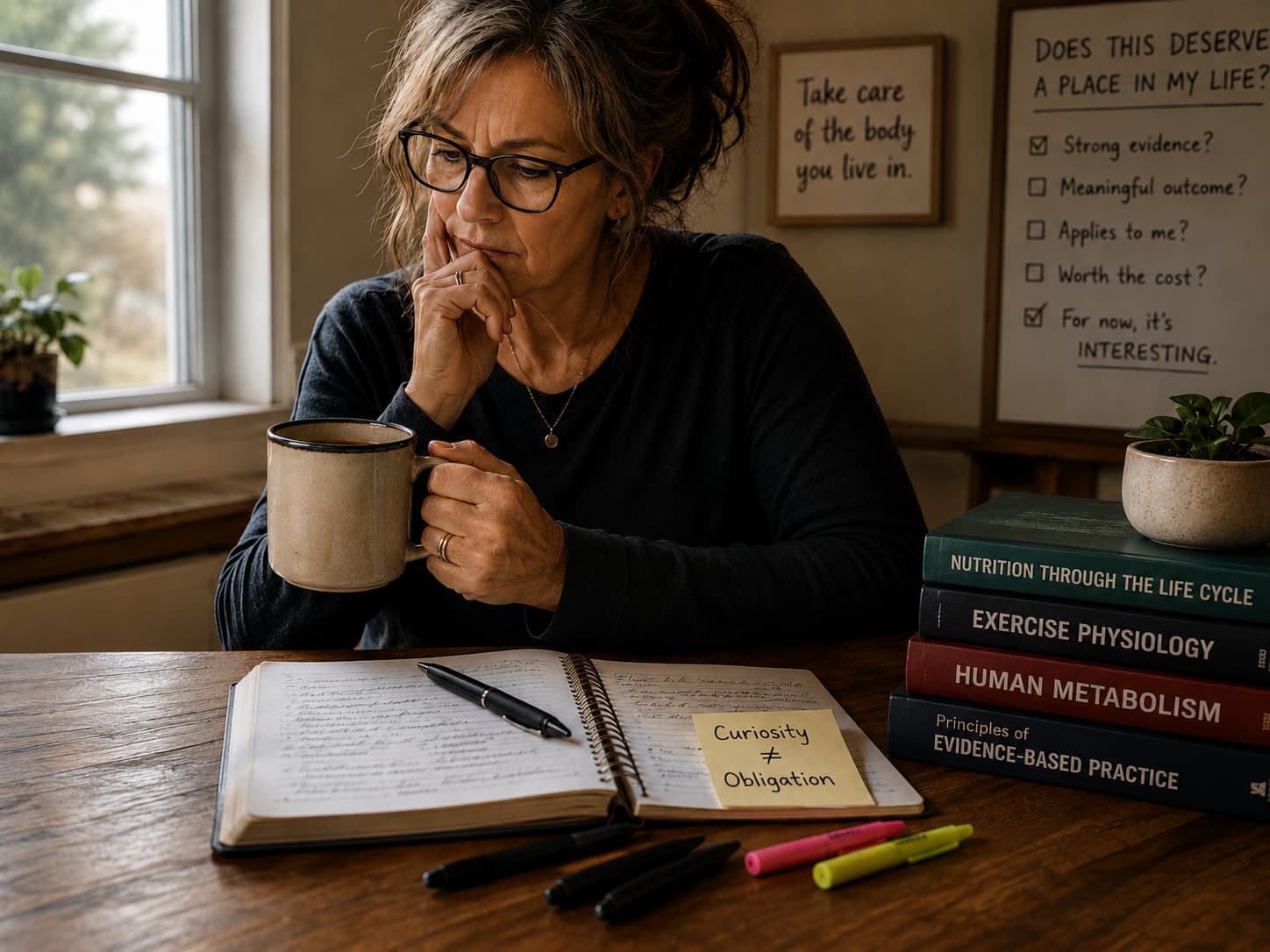
What I do not want is to confuse curiosity with obligation.
Every time I learn that something affects the body, I do not have to incorporate it into my daily operating procedure. Sometimes an investigation will uncover something important enough that I should change what I am doing. Sometimes it will uncover something I ought to document, watch or take to someone with more expertise. Sometimes it will expose a much bigger problem than the one I thought I was looking at.
And sometimes I am going to reach the end of the thread, understand the subject better than I did before and decide that absolutely nothing in my life needs to change.
That is not wasted inquiry. That is the inquiry doing its job, because the point cannot be to accumulate the greatest possible number of health instructions before we die.
I would rather get better at knowing which ones deserve to come home with me.
The caffeine can stay interesting.
I’m keeping my coffee where it is.
ONE MORE THING WORTH NOTICING
Want to keep pulling on threads like this one?
Moxie Moments is my occasional note about what I’m noticing, questioning, and still chewing on—in health and in life.
Quick Takeaways
- A finding can be scientifically real without being important enough to change your daily life.
- Ask what a study actually measured before translating a mechanism or short-term effect into a long-term outcome.
- Health information needs proportion: evidence strength, relevance to your circumstances, likely size of effect, and the cost of acting on it all matter.
- “Interesting” is a legitimate conclusion. Learning something does not obligate you to turn it into another rule.
- Good inquiry can end with a change, more observation, a professional conversation—or a reasoned decision to do nothing.
Referenced Studies & Sources
| Title | Link |
| Effects of Different Caffeine Doses on Fat Oxidation and Cardiovascular Response During Exercise at FATmax in Overweight/Obese Female College Students | https://pubmed.ncbi.nlm.nih.gov/42120324/ |
| Effect of Acute Caffeine Intake on Fat Oxidation Rate During Fed-State Exercise: A Systematic Review and Meta-Analysis | https://pubmed.ncbi.nlm.nih.gov/38257100/ |
| Does Caffeine Increase Fat Metabolism? A Systematic Review and Meta-Analysis | https://pubmed.ncbi.nlm.nih.gov/36495873/ |
| Effect of Acute Caffeine Intake on the Fat Oxidation Rate During Exercise: A Systematic Review and Meta-Analysis | https://pubmed.ncbi.nlm.nih.gov/33255240/ |